Temporary Construction Fencing and Barricades in Jacksonville, FL: Permits, Pedestrian Rules, Costs and Steps
Short answer: Temporary fencing and barricades on a Jacksonville demolition or construction site do two different jobs, and each has its own rulebook. Inside your property line, the fence keeps people and animals out. The Florida Building Code, Chapter 33 (the 8th Edition, 2023, is the edition the City’s Building Inspection Division lists), sets the pedestrian-protection rules: construction railings at least 42 inches high, solid barriers at least 8 feet high, a walkway at least 4 feet wide, and a covered walkway when the work is tall and close to the lot line. Once any fence, barricade, sign, lane marker or equipment storage reaches a City road, sidewalk, swale or easement, Ordinance Code Section 744.110 requires a Right-of-Way (ROW) permit. The City’s published fees are $127 for a residential ROW permit and $191 for a commercial one, doubled if work starts first. The contractor needs a ROW surety bond on file and an approved Maintenance of Traffic (MOT) plan. Published 2026 cost guides put a one-month, 60-foot temporary fence rental at about $150 to $500 with delivery and installation (Angi), and chain-link panels at $20 to $50 per 6′ x 12′ panel per month (HomeGuide and Fixr).
This guide covers fencing and barricades in Jacksonville in the order the decisions usually come up: what the work involves, which Florida Building Code rules apply to pedestrians, when the City’s right-of-way and traffic rules take over, what published cost guides say, what happens to the materials afterward and what to ask in a quote. It builds on our other Jacksonville guides, including the house demolition permit, asbestos and cost guide, the roll-off dumpster and right-of-way guide and the driveway removal right-of-way guide. Arwood Site Services of Jacksonville can set up fencing and barricades as part of a demolition or site-clearing job.
What does temporary fencing and barricade work involve in Jacksonville?
The phrase covers several different products, and the right one depends on what you are protecting and from whom. On a typical Jacksonville job the pieces fall into these groups:
- Perimeter fence. Freestanding galvanized chain-link panels, usually 6 feet high and 10 or 12 feet long, held up by stands, clamps and sandbags or ballast. This is the usual choice around a house demolition, a cleared lot, a pool removal or a commercial tear-down.
- Privacy screen or windscreen. Mesh fabric zip-tied to the panels to hide the site and cut down on blowing dust. In a Florida wind event, fabric turns a fence into a sail, so the fence and its ballast have to be planned for it.
- Solid barrier, or “hoarding.” Plywood or board walls, usually 8 feet high, used along a sidewalk. This is the barrier the Florida Building Code describes when a site is tall and close to the lot line.
- Pedestrian barricades and construction railings. Lighter units, 42 inches or higher, that steer people around an area. Metal barricade panels, A-frame barricades and Type III barricades are all in this group.
- Covered walkways. A roofed, lit, structurally designed walkway that lets pedestrians keep using a sidewalk below overhead work.
- Excavation barriers. A taller fence or barrier around an open hole near the street, such as a removed pool, a basement or a footing trench.
- Orange mesh. Lightweight plastic fencing that marks an area. It is cheap and visible, but Angi notes it is not classified as safety fencing, and the MUTCD says tape, rope or plastic chain strung between devices should not control pedestrian movement.
Jacksonville adds a few local conditions. The city is large and mixed: older neighborhoods such as Riverside, Avondale, San Marco and Springfield often have houses close to the sidewalk, while newer suburban lots have deep setbacks. A house 40 feet back from the lot line can be fenced entirely on private land. A downtown storefront or an infill lot 4 feet from the sidewalk often cannot. Hurricane season matters too, because loose panels, screens and sandbags can become projectiles, and a fence left up on an inactive site needs a plan before a storm.
Fencing is also not the only barrier on a lot. Landscape and tree protection rules in the City’s Zoning Code (Chapter 656, Part 12) can require protective barriers around trees that stay. Those requirements are separate from site fencing, so ask the City’s Planning and Development staff for the barrier specification at your address before the excavator arrives.
Does the Florida Building Code require fencing or barricades on a demolition site?
Chapter 33 of the Florida Building Code, Building, “Safeguards During Construction,” is the section that matters. It protects pedestrians during construction, remodeling and demolition. It does not say that every site needs a fence, but it does say a demolition may not start until pedestrian protection is in place. Section 3303.2 reads: “The work of demolishing any building shall not be commenced until pedestrian protection is in place as required by this chapter.”
Table 3306.1 sets the type of protection by height of the work and distance to the lot line:
| Height of construction | Distance from construction to lot line | Protection required |
|---|---|---|
| 8 feet or less | Less than 5 feet | Construction railings |
| 8 feet or less | 5 feet or more | None |
| More than 8 feet | Less than 5 feet | Barrier and covered walkway |
| More than 8 feet | 5 feet or more, up to one-fourth of the height | Barrier and covered walkway |
| More than 8 feet | Between one-fourth and one-half of the height | Barrier |
| More than 8 feet | More than one-half of the height | None |
Read that table with a real example. A two-story house is roughly 20 to 25 feet to the roofline. If the wall being demolished is within a quarter of its height of the lot line (about 5 to 6 feet), the code calls for both a barrier and a covered walkway. If it is more than a quarter but less than half the height away (roughly 6 to 12 feet for that house), a barrier is enough. Farther than half the height, the table requires no pedestrian protection. The table is a code minimum for pedestrians; the building official, your insurer and common sense can still call for fencing on a site that is far from the street.
The other Chapter 33 details that come up most often are these:
- Walkways (3306.2). A walkway has to be provided in front of every construction and demolition site unless the governing authority authorizes the sidewalk to be fenced or closed. Walkways must be at least 4 feet wide, have a durable walking surface, be accessible under the code’s accessibility chapter and be designed for a live load of at least 150 pounds per square foot.
- Directional barricades (3306.3). When the walkway extends into the street, a directional barricade must be large and strong enough to direct vehicles away from the pedestrian path.
- Construction railings (3306.4). At least 42 inches high and sufficient to direct pedestrians around the work.
- Barriers (3306.5 and 3306.6). At least 8 feet high, on the side of the walkway nearest the construction, running the entire length of the site, with openings protected by doors that are normally kept closed. The code gives a prescriptive wood design (2×4 top and bottom plates and minimum panel thicknesses, with stud spacing tied to panel thickness); anything else must be designed for the Chapter 16 loads. That load requirement is the reason a flimsy mesh fence does not satisfy the “barrier” row in the table.
- Covered walkways (3306.7). At least 8 feet of clear height, adequate lighting at all times and a design live load of at least 150 psf, with a limited exception and prescriptive framing option for light-frame construction of two stories or fewer.
- Maintenance and removal (3306.8). Protection must be kept in good order for the entire time pedestrians could be endangered. When the work is done, the owner or agent must immediately remove walkways, debris and other obstructions and leave public property in as good a condition as before.
- Excavations (3306.9). An excavation 5 feet or less from the street lot line must be enclosed with a barrier at least 6 feet high. Farther away, a barrier is required where the building official requires it, and barriers must resist wind pressure under Chapter 16.
Section 3307 also requires protection of adjoining public and private property during demolition, and Section 3308 covers temporary use of streets, alleys and public property. Both are worth reading when a fence line, a staging area or a dumpster is going to touch the street. The published chapter is available from UpCodes and the official ICC code library. The building official’s adopted amendments control, so confirm the version that applies to your permit.
When do the City of Jacksonville’s right-of-way rules apply?
The building code asks what you must protect. The City’s right-of-way rules ask where you are allowed to put things. Section 744.110 of the Ordinance Code requires a written permit to “disturb, excavate, block, obstruct, tamper with or place any construction or other material on or in” a public road, right-of-way or easement. The City’s Right of Way Permitting page does not name fences or barricades in so many words. A barricade standing in a lane, a fence line built out onto the sidewalk or swale, and a sign or cone set in the street all fit the “block, obstruct or place” language, and the same logic applies to the dumpster rules in our roll-off guide. If the entire fence, gate swing and storage area stay on your own lot, the City’s ROW process generally does not come into play. We did not find a separate City fee for a temporary construction fence that sits wholly on private land; ask the Building Inspection Division if your permit package lists one.
The details that matter if you do touch the right-of-way:
- Who applies and how. ROW permit applications are submitted and reviewed through JaxEPICS. The contractor performing the work must have a current ROW surety bond on file with Development Services before applying, and must have a valid approved permit and a copy of it available during construction. The City warns that if you are not the one doing the work, you should not pull the permit, because the person who pulls it is liable for the work.
- Fees. The City Fees schedule lists a residential ROW permit at $127.00 and a commercial ROW permit at $191.00. The schedule says those fees are automatically doubled when work in the right-of-way starts before plans are approved, fees are paid and a permit is issued.
- Maintenance of Traffic (MOT). The City says the contractor must have an approved MOT plan for any work or equipment storage that will affect vehicular or pedestrian traffic. Traffic control must follow the Florida Department of Transportation (FDOT) manual on traffic controls and safe practices. If the work will change normal traffic patterns, full coordination with and approval from Traffic Engineering is required. For the standard MOT details, the City’s procedures manual lists Traffic Engineering at (904) 255-8310.
- Peak hours. When work closes a lane or otherwise affects traffic during weekday peak periods, 7 a.m. to 9 a.m. and 4 p.m. to 6 p.m., permission has to come from Traffic Engineering, and proof of that permission must be on the job site at all times.
- One half of the road stays open. The permit application’s general conditions say that in pavement or sidewalk, one half of the roadway must be kept open to traffic at all times unless the City Traffic Engineer approves otherwise. The same conditions say a copy of the permit must be on the job site and that excavations left open after sundown must be marked with lights.
- Penalty. The City’s “Do I Need a Right of Way Permit?” page says work without a required permit can bring a fine of not more than $250 or imprisonment of not more than ten days, with each day counted as a separate offense.
- State roads are different. You do not need a City ROW permit in an FDOT right-of-way or on a private road. The City points people to FDOT at (904) 360-5200 for a list of state-maintained rights-of-way. Many of Jacksonville’s busiest corridors are state roads, so check who owns the street in front of the site before you apply anywhere.
The City’s sidewalk rules sit alongside the building code. A walkway “in front of every construction and demolition site” is a code requirement unless “the applicable governing authority authorizes the sidewalk to be fenced or closed.” In Jacksonville, the practical route for that authorization is the right-of-way permit and MOT approval, not a verbal okay from a neighbor or a property manager. Jacksonville Beach, Atlantic Beach, Neptune Beach and Baldwin have their own departments and their own streets, so a City of Jacksonville ROW permit does not cover work in those cities.
What are the rules for closing a sidewalk or protecting pedestrians?
Florida adopted the federal Manual on Uniform Traffic Control Devices through Rule 14-15.010, F.A.C., and FDOT lists the 11th Edition with Revision 1 as the current version. Part 6 of the MUTCD covers temporary traffic control, and Chapter 6C covers pedestrians in work zones. The parts most relevant to a fence line next to a sidewalk are:
- Adequate access. If a temporary traffic control zone affects pedestrians, “adequate pedestrian access and walkways shall be provided” (Section 6C.02).
- A path that resembles the original. Pedestrians should be given a convenient and accessible path that replicates, as nearly as practical, the characteristics of the existing sidewalk, and a pedestrian route should not be severed or moved for non-construction uses such as parking vehicles and equipment.
- Width and passing space. The MUTCD says the width of the existing facility should be provided if practical, and when a 60-inch minimum width cannot be maintained for the full length, a 60 x 60-inch passing space should be provided at least every 200 feet so wheelchair users can pass. The Florida Building Code’s 4-foot minimum walkway is the floor in the code; the MUTCD guidance for accessibility is wider.
- Detectable barriers. When a pedestrian facility is closed, the temporary facilities must include accessibility features consistent with the existing facility, and “a barrier that is detectable by a person with a vision disability traveling with the aid of a long cane shall be placed across the full width of the closed pedestrian facility” (Section 6C.03).
- No tape or rope. The MUTCD says tape, rope or plastic chain strung between devices should not be used to control pedestrian movements because it is not detectable. It says temporary traffic barriers and wood or chain-link fencing with a continuous detectable edging can satisfactorily delineate a pedestrian path.
FDOT’s Standard Plans for fiscal year 2025-26 include Index 102-660, “Sidewalk Closure,” which gives typical pedestrian-detour layouts. FDOT’s own instructions describe it as a “rudimentary” guide that sets minimum requirements for signs and channelizing devices, and say to use it as a guide when building project-specific plans. A City MOT plan for a short sidewalk closure often borrows from that kind of layout. An experienced traffic-control provider can draw it, and you should not try to improvise it from rental panels and a few cones.
What does temporary fencing and barricade rental cost? Published 2026 ranges
Costs below come from national and regional published sources, not from Jacksonville quotes and not from Arwood Site Services. Fence rental is priced by linear foot or by panel, per month, with delivery, installation and removal sometimes bundled and sometimes separate.
| What | Published figure | Source |
|---|---|---|
| One-month rental, 60 linear feet, delivered and installed | $150 to $500; national average $350 | Angi, updated Oct. 16, 2026 |
| Barricade-style temporary fencing, 60 feet per month | $150 to $300 | Angi |
| Security-style temporary fencing, 60 feet | $135 to $500 | Angi |
| Orange plastic fencing, 60 linear feet | About $60 | Angi |
| Add-ons (gates, padlocks, shade cloth, sandbags) | $150 to $400 total; gate $100 to $400 each; padlock $20 to $40; shade cloth about $200 per 60 feet; sandbags $3 to $8 each per month | Angi |
| Installation labor billed separately | $30 to $50 per hour | Angi |
| 60 feet including installation, couplers and a gate | $200 to $1,000 per month | HomeGuide, 2026 edition (page dated June 3, 2024) |
| Chain-link panel, 6′ x 12′ | $20 to $50 per panel per month | HomeGuide; Fixr (also $20 to $70 for construction use) |
| Barricade fencing panels | $20 to $60 per panel per month, plus $5 to $15 per base per month | HomeGuide |
| Privacy or security panels; traffic-control fencing | $25 to $80; $20 to $60 per panel per month | HomeGuide |
| Fence bases, sandbags, clamps | $5 to $15 per base per month; $5 to $10 per sandbag; $1 to $5 per clamp | HomeGuide |
| Privacy screen or windscreen | $100 to $300 per rental | HomeGuide |
| Typical short-term rate per linear foot | $1.50 to $4.00 per linear foot per month; professional installation $1.00 to $2.00 per linear foot | FenceRentalService, Jan. 20, 2026 |
| One vendor’s per-foot rate, 1 to 3 months | $3.50 per linear foot, including standard delivery, setup and pickup; pickup-only rate $1.95 per linear foot | Ideal Rental, Mount Vernon, Washington (updated May 26, 2026) |
| Type III barricade, 8 ft | $15 per day, $35 per week, $95 per 31 days, before delivery | Total Rental, Everett, Washington |
| Type III barricade set of five | $25 per day, $90 per week, $195 per month | Horizon Equipment via DTX Rental Command |
A few notes on reading those numbers. First, a 60-foot run is a small site. A typical lot fence may be 150 to 300 feet around the work area, so multiply by the actual linear footage. Using Angi’s per-60-foot range as a rough rule, 240 feet would be four times the $150 to $500 range. That is arithmetic, not a quote. Second, the Washington State rental yards are listed because they publish prices openly; Jacksonville vendors may be higher or lower, and delivery, tax and damage waivers are not included in the barricade figures. Third, HomeGuide’s own page is dated 2024 and Fixr’s range comes from its national database, so treat both as context for Angi’s more recent figures.
Costs the published guides do not capture well in Jacksonville are the City ones: the $127 or $191 ROW permit, the ROW bond premium (set by the bonding company), an MOT plan prepared by a qualified traffic-control provider, and any required lane or sidewalk-closure devices. Those costs apply only when the fence or barricades touch the public right-of-way, which is another reason to keep a fence on private land when the site allows it.
Where do the fencing and barricade materials go afterward, and what are the disposal rules?
Rented panels, stands and barricades go back to the rental yard, and the cost of anything damaged, bent or missing is typically billed to the renter. Rental agreements commonly bill for damaged or missing pieces, so walk the line and count pieces when you return it. Windblown fabric and zip ties are small items that crews often forget, and they end up in neighbors’ yards.
What does end up in a dumpster is mostly site-built material: plywood hoarding, lumber, stakes, broken pallets, orange mesh and torn windscreen. Those are ordinary construction-and-demolition (C&D) debris. The City Fees schedule (Section 380.303) lists C&D disposal at facilities with scales at $22.71 per ton for debris generated inside the city and $30.30 per ton for debris generated outside the city. Many haulers fold disposal into the container price and bill an overage if the load is heavy, so ask what is included. Sandbags are a separate case: if they were used around contaminated material or concrete wash, ask your hauler before they go in a standard box. Clean wood and metal can often be pulled out for recycling; Arwood Site Services recycles concrete, brick, metal and wood where the material allows.
If the fence line is going to restore a damaged swale or sidewalk edge, remember Chapter 33’s closing rule: walkways, debris and obstructions must be removed immediately, and public property must be left in as good a condition as it was before. Photos of the sidewalk, curb and swale before the fence goes up are cheap protection against a dispute at the end.
What are the steps to fence and barricade a demolition site in Jacksonville?
- Measure the site and the setback. Note the height of the structure, the distance from the work to every lot line, and whether a sidewalk, swale or easement is within reach of the fence. Table 3306.1 uses those numbers.
- Find out who owns the street. City streets use the City ROW process. FDOT roads use FDOT’s. Private roads and unmaintained City rights-of-way have their own rules.
- Choose the protection level. Pick perimeter fence, construction railings, a barrier or a barrier with a covered walkway, based on Chapter 33 and your building permit. Ask the building official when the table gives you “none” but the site is still near the public.
- Decide the sidewalk plan. Keep the sidewalk open with a protected walkway, or get the City’s authorization to close it. For a closure, plan an alternate route, a detectable barrier across the full width and signage in the MOT plan.
- Line up the bond, permit and MOT. A bonded contractor applies for the ROW permit in JaxEPICS, with MOT approval from Traffic Engineering where traffic or pedestrians are affected. Do not start work in the right-of-way first, because the fees double.
- Mark utilities and set the fence. If posts or stakes go into the ground, call Sunshine State One Call of Florida first, as the City requires before digging. Set panels with stands, clamps, ballast or bracing, hang gates where trucks need to enter and keep gate swing off the sidewalk.
- Post the signs and the paperwork. Keep a copy of the ROW permit and any peak-hour approval on site. Add signs that direct pedestrians, and lighting where the walkway is covered or where excavations are open after dark.
- Inspect and maintain it. Check the line after wind, rain and truck traffic. Fix leaning panels, reattach screens and re-close gates. Chapter 33 requires protection to be maintained for as long as pedestrians could be endangered.
- Remove it, restore the area and close out the permit. Take the fence down as soon as the hazard is gone, repair any damaged sidewalk, curb or swale, and return rental equipment with a count.
How can you keep fencing and barricade costs under control?
- Keep the fence line on your own lot when the site allows it. That avoids the ROW permit, the bond and an MOT plan.
- Order the right length. Measure the actual perimeter, count gates and corners, and ask whether the price per foot includes stands, clamps and delivery.
- Ask whether installation and removal are in the monthly price. Published guides show installation billed anywhere from bundled to $1.00 to $2.00 per linear foot, or $30 to $50 per hour.
- Plan the schedule. Rent starts at delivery, so book the fence for the week the crew mobilizes, not a month before.
- Add wind protection only where it is needed. Windscreen helps with dust and privacy but adds sail area, so confirm the ballast plan before ordering it.
- Bundle the work. Fencing, a roll-off container and the demolition itself can often be on one schedule and one invoice, which avoids paying for the fence while waiting on another vendor.
- Keep the paperwork. A copy of the ROW permit, MOT approval and the code section you used to size the barrier are the first things an inspector or a neighbor will ask for.
Frequently asked questions
Do I need a permit for a temporary construction fence in Jacksonville?
If the fence, barricades, signs or stored materials will be on or in a City street, sidewalk, swale or easement, Ordinance Code Section 744.110 requires a Right-of-Way permit. If everything stays on your own private lot, the City’s ROW process generally does not apply, so check the demolition or building permit conditions for fence requirements. We did not find a separate City fence fee for a temporary fence on private land, so confirm with the Building Inspection Division for your address.
How much does a ROW permit for barricades or a sidewalk closure cost?
The City Fees schedule lists $127.00 for a residential ROW permit and $191.00 for a commercial one, doubled if work starts before the permit is issued. The contractor also needs a ROW surety bond on file, and an MOT plan is required for work that affects vehicles or pedestrians. The bond premium and the cost of the MOT plan are set by the bonding company and the traffic-control provider.
How tall does a barrier have to be?
The Florida Building Code requires solid barriers at least 8 feet high where Table 3306.1 calls for a “barrier,” construction railings at least 42 inches high for low work near the lot line, and a barrier at least 6 feet high around an excavation within 5 feet of the street lot line.
Can I close the sidewalk in front of my demolition site?
Only with authorization. The code requires a walkway in front of every construction and demolition site unless the governing authority authorizes the sidewalk to be fenced or closed. In Jacksonville that generally means a ROW permit and approved MOT plan, with an alternate route and a detectable barrier across the full width of the closed sidewalk.
How wide does a temporary pedestrian walkway need to be?
The Florida Building Code sets a minimum of 4 feet. The MUTCD says the width of the existing sidewalk should be provided if practical, and where 60 inches cannot be maintained for the full length, a 60 x 60-inch passing space should be provided at least every 200 feet.
Is orange mesh fencing enough?
For marking an area on private land, it can be. Angi notes that it is not classified as safety fencing. It does not meet the Building Code’s barrier requirement where a barrier is required, and the MUTCD says flimsy strung devices should not control pedestrian movement.
How much does it cost to rent construction fence?
Angi puts a one-month, 60-foot rental at $150 to $500 including delivery and installation, with a $350 national average. HomeGuide and Fixr both list chain-link panels at about $20 to $50 per 6′ x 12′ panel per month. Local pricing, length, gates, screens and rental duration change the final number.
Who handles fencing on a state road?
If the street is an FDOT right-of-way, the City ROW permit does not apply. The City refers people to FDOT at (904) 360-5200 for a list of state-maintained rights-of-way and says FDOT has its own requirements. Check which agency owns the street before you apply.
What about hurricanes?
Barriers must be designed for wind loads under Chapter 16 unless they follow the code’s prescriptive wood design, and excavation barriers must resist wind pressure. In practice, that means ballast, bracing and removing or securing screens ahead of a storm, and having a plan for panels on any site that sits idle during hurricane season.
Are Jacksonville Beach, Atlantic Beach and Neptune Beach on the same rules?
No. Those cities and Baldwin have their own building and public-works departments. The Florida Building Code applies statewide, but the right-of-way permit, fees and traffic approval come from the agency that owns the street.
Get a free fencing and barricade quote in Jacksonville
Planning a demolition, site-clearing or pool-removal job that needs a fence, barricades or sidewalk protection? Arwood Site Services of Jacksonville will help you work out which protection applies, whether a City right-of-way permit is likely to be needed and what a written quote should include.
- Call (904) 305-7534
- Email [email protected]
- Request online: Get a Quote
You can also follow Dependable Demolition on Facebook and LinkedIn for job updates and service news.
Learn more on our Fencing & Barricades, roll-off dumpster and demolition services pages, or read the interior demolition guide and the Jacksonville demolition costs and permits guide if your project involves more than a fence.
Sources
- 2023 Florida Building Code, Building, 8th Edition, Chapter 33 Safeguards During Construction (UpCodes) and the ICC code library
- City of Jacksonville, Right of Way Permitting
- City of Jacksonville, Do I Need a Right of Way Permit? (updated Aug. 4, 2026)
- City of Jacksonville, Right of Way Permit Application and general conditions
- City of Jacksonville, Major Utility Construction (MOT details and Traffic Engineering contact)
- City of Jacksonville, City Fees (ROW permit fees; Sec. 380.303 C&D disposal rates)
- JaxEPICS
- MUTCD 11th Edition, Revision 1, Chapter 6C Pedestrian and Worker Safety (FHWA publishes the official Part 6 PDF)
- FDOT, Manual on Uniform Traffic Control Devices (Rule 14-15.010, F.A.C.)
- FDOT, Standard Plans Instructions, Index 102-660 Sidewalk Closure, FY 2025-26
- Angi, How Much Does Temporary Fence Rental Cost? [2026 Data], updated Oct. 16, 2026
- HomeGuide, How Much Does it Cost to Rent a Fence? (2026)
- Fixr, Temporary Fence Rental Cost
- FenceRentalService, Chain Link Fence Rental Cost Guide, Jan. 20, 2026
- Ideal Rental, Temporary Fence Construction Rentals (updated 5/26/2026)
- Total Rental, Barricade Type III 8 ft
- Horizon Equipment via DTX Rental Command, Barricade Type III Set (5ct)
Code text, City fees and traffic-control rules were checked November 17, 2026. Cost figures are published ranges and vendor price lists from the sources above; they are not quotes from Arwood Site Services and out-of-state vendor prices are examples only. Rules differ by address, street owner and jurisdiction, so confirm the current requirements and fees with the City of Jacksonville, FDOT or the building official before work is scheduled.
Jacksonville Building Permit Roundup: What This Week’s Development Today Permits Mean for Demolition and Clean-Up
Short answer: The Jacksonville Daily Record’s “Development Today” column lists the largest commercial building permits the City issues each day, and the four columns published November 11 through November 16, 2026 show what a typical week looks like: tenant build-outs, renovations, new buildings and, on November 12, one permit that was explicitly for demolition. Every permit below is quoted from those columns with a link to the source article. Each one is a signal that debris, old finishes or site clean-up is coming, which is exactly when a roll-off dumpster and a demolition plan matter.
This is a Monday permit roundup from Jacksonville Demolition Services. We do not know the owners’ plans beyond what the column prints, and nothing here is a statement about who is or is not hiring us. We read the permit list for what it says about the kind of work moving through the City and what that work usually generates. If you are planning something similar, you can get a quote or call (904) 305-7534.
The demolition permit in this week’s column
The most direct item is in the November 16 column, covering permits issued November 12, 2026. Under “Government,” the Daily Record lists: JIA, 2400 Yankee Clipper Drive, contractor is J.D. Hinson Co., 10,100 square feet, parking garage selective demolition, $950,000. Source: Development Today: Philips Highway RaceTrac plans $1 million renovation.
“Selective demolition” means removing specific parts of a structure while the rest stays standing. On a parking structure that usually means concrete, topping, expansion joints, railings, lighting or sections of deck, and it produces heavy, dense debris. Concrete and masonry are the kind of material that fills a roll-off quickly by weight rather than by volume, so container size and haul weight are the planning questions, not just yard count. We have no information about how that contractor is handling disposal; the point is what this type of permit generally means for the debris stream.
Other permits from the same column
The same November 16 column also lists, for permits issued November 12:
- Lane Industrial Park, 2240 Lane Ave. N., No. 105, contractor is Premier American Construction Inc., 971 square feet, office addition inside warehouse, $178,227.
- RaceTrac Petroleum Inc., 11760 Philips Highway, contractor is Venture Construction Co., interior and exterior renovation, $1 million.
A renovation that touches both interior and exterior, and an office built inside a warehouse, both involve removing old material before new material goes in: ceilings, flooring, partitions, storefront or exterior finishes, and packaging and framing waste from the new work.
November 13 column: build-outs and new site work
The November 13 column, covering permits issued November 11, lists (source: Development Today: Harbor Freight building-out in Pablo Station shopping center):
- Broward Key, 485 Grand Beacon Blvd., contractor is K&G Construction Co. Inc., new pavilion, $300,000.
- The Arbors, 4171 Hemlock St., contractor is K&G Construction Co. Inc., new dog park and pool shade structures, $29,000.
- Buckman Bridge Unitarian Universalists Society Inc., 8447 Manresa Ave., contractor is J&B Quality Construction Services Inc., new wood deck, $67,800.
- S+S Industries, 10175 Inlight Way, Bldg. 400, No. 100, contractor is Superior Industrial Group Inc., 55,080 square feet, tenant build-out, $231,171.
- Harbor Freight, 14333 Beach Blvd., No. 18, contractor is Marco Contractors inc., 16,958 square feet, tenant build-out, $400,000.
November 12 column: renovations, a portico repair and a $10 million shell building
The November 12 column, covering permits issued November 10, includes (source: Development Today: LoveShackFancy approved for build-out):
- Magnolia Villas at Jacksonville, 10505 103rd St., contractor is ET&T Distributors Inc., install new playground equipment, $39,000.
- Fairfield Inn & Suites, 4888 Lenoir Ave., contractor is Coastal Living Construction LLC, portico repair, $91,000.
- Johnson & Johnson Vision Products Inc., 7500 Centurion Parkway, contractor is Gilbane Building Co., 1,000 square feet, injection mold lab renovation, $1.9 million.
- Imperial Nail Lounge, 12220 Dairy Ridge Road, No. 5, contractor is BAO Construction LLC, 2,820 square feet, tenant build-out, $350,000.
- Jacksonville Riverfront Plaza, 2 Independent Drive W., contractor is The Haskell Co., 6,083 square feet, new Beer Garden shell building, $10 million.
- LoveShackFancy, 4813 River City Drive, No. 113, contractor is David A. Nice Builders Inc., tenant build-out, $460,424.
November 11 column: pools, a boardwalk and several build-outs
The November 11 column, covering permits issued November 9, lists (source: Development Today: Dolce Gelato artisan gelato shop coming to Mandarin):
- Jacksonville Golf & Country Club Inc., 3985 Hunt Club Road, contractor is Elkins Construction LLC, new swimming pool, $1.7 million.
- Spanish Point Civic Association Inc., 1907 Tomas Drive, contractor is United Pool Pros LLC, swimming pool repair, $88,440.
- Fleet Landing, 8000 Fleet Landing Blvd., contractor is Harbor Marine Dock Co. Inc., boardwalk improvements, $4.1 million.
- Walmart, 2240 Lane Ave. N., No. 101, contractor is Newco Construction of America Inc., 20,750 square feet, storage build-out, $520,000.
- McCurdy-Walden Inc., 5267 Commonwealth Ave., contractor is Rowe Buck Inc., 1,200 square feet, new warehouse building, $100,000.
- Belfort I, 7751 Belfort Parkway, Nos. 230 and 235, contractor is 2JBR Construction Services LLC, 3,376 square feet, tenant build-out, $42,200.
- Dolce Gelato Inc., 10550 Old St. Augustine Road, No. 22, contractor is AEC Integrated LLC, 1,020 square feet, tenant build-out, $32,000.
- River City Science Academy, 8160 Baymeadows Way W., contractor is OM Innovation Construction LLC, 14,000 square feet, new building, $1.54 million.
- Publix Liquors, 12235 Dairy Ridge Road, No. 10, contractor is J. Raymond Construction Corp., 2,420 square feet, tenant build-out, $279,776.
- King Jack Smoke & Vape Inc., 1927 Kings Road, No. 4, contractor is AEC Integrated LLC, 1,400 square feet, tenant build-out, $45,000.
The Daily Record describes these columns as “the largest commercial building permits by job cost issued” each day by the City of Jacksonville, so they are a sample of the biggest jobs, not every permit.
What these permits mean for demolition, clean-up and roll-off needs
Reading across the four columns, the permits fall into a few patterns, and each one implies a different kind of debris:
- Tenant build-outs (Harbor Freight, S+S Industries, LoveShackFancy, Imperial Nail Lounge, Walmart storage space, Belfort I, Dolce Gelato, Publix Liquors, King Jack Smoke & Vape). Space is rarely empty. Old ceilings, partitions, flooring, fixtures and sometimes mechanical runs come out first, followed by drywall scrap, framing off-cuts, cardboard and packaging. A mid-size dumpster that stays through demolition and construction is a common arrangement.
- Renovations and repairs (RaceTrac, Johnson & Johnson Vision Products lab, Fairfield Inn portico, pool repair, boardwalk improvements). These are selective tear-outs: material comes off in pieces over days, so container swaps and staging space matter more than one big haul.
- Selective demolition (the JIA parking garage permit). Heavy, dense debris such as concrete and steel, where weight limits drive the container choice.
- New buildings and structures (River City Science Academy, the Beer Garden shell, McCurdy-Walden warehouse, pavilions, decks). Site clearing, concrete washout, packaging and construction scrap rather than demolition debris, though older material on the site may need to be cleared first.
For homeowners and small businesses the lesson is the same at a smaller scale: when a permit is pulled, a debris plan should be made at the same time, not after the first wall comes down.
City permit and disposal rules to keep in mind
Permits in Jacksonville are applied for and tracked through JaxEPICS, the City’s online permit portal. A few rules from City and state documents we reviewed for our recent guides apply to nearly any project in the lists above:
- Alterations, repairs, change of use and demolishing a building generally require a permit. The City’s Building Inspection Division FAQ lists them, and permits are good for 180 days once issued.
- A Notice of Commencement is required on most jobs over $5,000.
- Asbestos rules can apply even to an interior job. For renovation, the City’s asbestos form applies when work will disturb more than 160 square feet, 260 linear feet or 35 cubic feet of suspect material, and a demolition includes partial demolition and removal of load-supporting members. When thresholds are met, expect a survey and a 10-working-day Florida DEP notice before work starts.
- Disposal has a posted price. The City Fees schedule lists $22.71 per ton for construction and demolition debris generated inside the city and $30.30 per ton for debris generated outside it at disposal facilities with scales, and manifested asbestos at $282.48 per ton. The City’s landfill is Trail Ridge Landfill.
For the full walk-through, see our guides to interior demolition permits, costs and steps, house demolition permits and asbestos and roll-off dumpster rental and right-of-way permits. Our building demolition page covers the services themselves.
Frequently asked questions
Does a building permit mean demolition is happening?
Not necessarily. Most permits in these columns are build-outs, renovations or new construction. Only the JIA entry is labeled demolition. Even so, many renovations involve tear-out work that produces debris.
Where can I see Jacksonville permits myself?
The City’s permit portal is JaxEPICS. The Jacksonville Daily Record’s Development Today column summarizes the largest commercial permits each business day.
Do I need a dumpster for a tenant build-out?
Often yes. Removing old ceilings, walls and flooring and then discarding construction scrap adds up quickly, and a container on site avoids repeated trips.
Can a dumpster go on the street?
Placement in the public right-of-way can need a separate City permit. Ask before delivery; our roll-off guide above explains the process.
How do I get a demolition or clean-up quote?
Use our Get a Quote page, call (904) 305-7534 or email [email protected].
Get a Quote
Whether you are gutting a suite, clearing a site or planning a selective tear-out, a quick call before the permit is pulled can save schedule time. Tell us the address area, the type of work and the timeline. Get a Quote, call (904) 305-7534 or email [email protected].
Follow Dependable Demolition on Facebook and LinkedIn.
Permit details are quoted from Jacksonville Daily Record “Development Today” columns published November 11, 12, 13 and 16, 2026, and were checked November 16, 2026. City fees and rules come from City of Jacksonville and Florida DEP documents reviewed November 15, 2026; confirm current requirements for your address.
Interior Demolition in Jacksonville, FL: Building Permits, Asbestos Rules, Costs and Steps
Short answer: Interior demolition in Jacksonville is a gut-out or selective tear-out that leaves the building standing. Crews remove finishes, fixtures and often non-load-bearing walls so a kitchen, bathroom, house or commercial suite can be rebuilt. This is usually an alteration, tenant-build-out or change-of-use permit in JaxEPICS, not the City’s demolition-of-buildings permit used for a full teardown. The City’s published alteration fee starts at $3.00 in Building Inspection Division (BID) charges for each $1,000 of estimated cost, with a minimum BID fee of $112.50 or $33.75 per required inspection, whichever is greater, plus plan review, a construction-and-demolition debris fee and, when those trades are involved, separate electrical, plumbing and mechanical permits. If the work disturbs enough suspect material, or if load-supporting members come out, the City’s asbestos rules and a Florida Department of Environmental Protection notice can apply before anyone opens a wall. Published 2026 national guides put most smaller interior jobs between about $1,097 and $5,054, with Angi listing a $3,046 average to gut a house and $800 averages to demo a kitchen or a bathroom.
This guide covers interior demolition in Jacksonville in the order the decisions usually come up: what the job involves, when a City building permit and asbestos or historic review apply, what published cost guides and the City fee schedule say, where the debris can go and what to ask in a quote. It is not a full-house teardown guide; that path, including the demolition permit fee formula and the seven-day grassing letter, is in our Jacksonville house demolition permit, asbestos and cost guide. Arwood Site Services of Jacksonville handles interior demolition for homeowners, investors and commercial tenants, and can include a roll-off container as part of the job.
What does interior demolition involve in Jacksonville?
Interior demolition is the controlled removal of what is inside a building so the structure can stay in use. A typical job strips rooms down toward the studs: drywall or plaster, ceilings, flooring, cabinets, counters, tubs, toilets, appliances and, when the new layout requires it, partition walls. The roof, exterior walls and foundation stay. That is the difference between a gut and a teardown, and it is why the City usually reviews this work as an alteration rather than as the demolition of a building.
In Jacksonville the work shows up in a few recurring forms:
- Kitchen and bathroom guts in existing houses, including older homes in neighborhoods such as Riverside, Avondale, Springfield and San Marco, where plaster, layered flooring and dated plumbing are common.
- Whole-house interior renovations for a flip, a flood repair or a layout change, where most rooms are opened up but the building remains.
- Commercial tenant improvements in offices, restaurants and retail suites downtown, along the Southbank or in older storefronts, often tied to a change of use and a new life-safety plan.
- Selective demolition, such as taking out one non-load-bearing wall, a bank of cabinets or a single floor finish, while protecting the rest of the occupied space.
The physical tear-out is only part of the job. Before walls come down, someone has to confirm whether a wall carries load, whether plumbing or wiring runs through it, whether suspect asbestos-containing materials will be disturbed and whether a City, beach-city or historic review applies. After the tear-out, the debris has to leave the site in a legal container and go to a permitted facility. A kitchen or bathroom gut often fits in a 10- or 20-yard roll-off if the box can sit on the driveway; sizing, weight limits and right-of-way placement rules are covered in our Jacksonville roll-off dumpster permit and cost guide.
Load-bearing walls change both the method and the paperwork. Removing a partition is a different job from removing a wall that holds up a floor or roof. The City’s asbestos requirements treat the removal of load-supporting members as demolition, not as a simple renovation, which can trigger a demolition notice to the Florida Department of Environmental Protection even when no asbestos is found. That is a reason to have the structure checked before anyone swings a hammer.
Do I need a City of Jacksonville permit for interior demolition?
Often yes, if the work is an alteration, a repair of regulated systems or a change in how the space is used. The Building Inspection Division’s FAQ says a building permit is required for any construction that physically changes or adds structures, or for work regulated by local codes, and it lists alterations, repairs such as rewiring or plumbing-fixture work, demolishing a building and a change of use among the examples (City of Jacksonville, Building Inspection Division FAQs). The same page cites the standard in Florida Building Code Section 105.1: a permit is required to construct, enlarge, alter, repair, move, demolish or change the occupancy of a building, or to install, alter, repair, remove, convert or replace electrical, gas, mechanical or plumbing systems regulated by the technical codes. The City is currently enforcing the Florida Building Code 8th Edition (2023).
The City’s published list of work that does not require a permit is short. It includes patio slabs, replacement of plumbing fixtures after the stop (excluding water heaters), stopping leaks, clearing drain stoppages that do not rearrange piping, and a handful of portable or internal mechanical exceptions. A kitchen or bathroom gut, new wiring, relocated plumbing or the removal of walls is not on that list. The residential permitting page also notes that the City does not inspect cosmetic items such as paint, wallpaper, carpet and interior door hardware. If your scope is only those finishes, ask the Building Inspection Division before you assume a permit is unnecessary. If the scope includes structural, electrical, plumbing or mechanical work, plan on a permit.
A few local details matter on the application:
- File in JaxEPICS. Online submission is required for all permit types. In addition to the application, the applicant uploads a completed Permission to Obtain Permits form, and documents must be in PDF format. The email entered as the project contact is the address that receives review notices. Plan-review time does not start until Zoning, Concurrency and Development Services have approved the plans for review and the plan-review fee has been paid (City of Jacksonville, Online Permit Submission).
- Agency reviews can sit in front of the building review. Depending on the scope and the address, the City may require reviews such as asbestos, historic preservation, the Downtown Investment Authority, FEMA or flood, or an Arlington CRA review. Those reviews have to finish before the Building Inspection Division begins its review.
- A change of use is its own path. If a commercial suite will be used as a different occupancy than the one on file, the City requires a converting-use building permit and, at a minimum, a life-safety plan and code summary from a Florida-licensed design professional. That review can lead to changes such as additional exits, restrooms, or fire-sprinkler or alarm work.
- Larger or structural jobs need a design professional. Under Chapter 320 of the Ordinance Code, as summarized on the City’s commercial permitting page, plans for alterations, repairs or improvements costing $25,000 or more must be prepared and approved by a Florida-registered architect or professional engineer. If the work involves structural design, those drawings are required in any case.
- A Notice of Commencement is required on most jobs over $5,000. Permits, once issued, are good for 180 days.
This alteration path is not the same as the City’s demolition-of-buildings permit. That permit, and its fee of $37.50 plus $12.50 plus a $400 construction-and-demolition debris charge per 1,000 square feet of floor area for a single-family residential building zoned residential, is the one used when the building itself is coming down. Do not budget a teardown fee for a gut-out, and do not skip an alteration permit because you already read the house-demolition guide.
A City of Jacksonville building permit does not cover every address in Duval County. Jacksonville Beach, Atlantic Beach, Neptune Beach and Baldwin issue their own building approvals. Confirm the building department that has jurisdiction at the property before you apply.
What does the City charge for an interior demolition or alteration permit?
For alterations, tenant build-outs and converting use, including major repair to buildings or other structures, Section 320.409(6) of the City Fees schedule sets the Building Inspection Division permit fee at $3.00 for each $1,000 of estimated cost or fractional part thereof, plus a $0.65 resource-management fee, a landscape fee equal to 12 percent of the BID permit fee, a $1.00 Development Services fee and a $0.90 construction-and-demolition debris fee, each also tied to that $1,000 increment. The minimum BID permit fee is $112.50 or $33.75 per required inspection, whichever is greater. The plan-review fee is 67 percent of the BID permit fee or $75.00, whichever is greater. For a converting-use permit where no inspections are required, the BID permit fee is $80.00 (City of Jacksonville, City Fees, Section 320.409).
A separate plans-examining fee under Section 123.102 lists alterations, tenant build-out and converting use at $2.00 per $1,000 of cost. Electrical, plumbing and mechanical work, when part of the project, have their own permit fees on the same schedule. Those trade permits are in addition to the building alteration permit, not a substitute for it.
On a modest single-room gut, the minimum BID fee and the minimum plan-review fee often matter more than the per-$1,000 rates. On a large commercial tenant build-out, the estimated construction cost is the number that moves the total. The figures above are the City’s published rates, not a quote, and they can sit alongside dumpster, abatement and contractor costs. Confirm the current fee for your estimated cost and inspection count before you budget.
Do historic districts or landmarks change an interior job?
Interior work that does not affect the exterior of the structure does not require a Certificate of Appropriateness (COA). If the same job changes windows, exterior doors or other exterior features such as a chimney, a COA is required before that work begins (City of Jacksonville, Historic Preservation FAQ).
A COA application is required for properties in the City’s locally designated historic districts and for locally designated landmarks when the work is on the exterior, including repairs to windows and siding and site work such as fencing, driveways and sheds. Once approved, a COA is valid for one year, and after work has begun it is valid for five years. Applications go through the City’s LUZAP portal. You can check an address or real-estate number on the City’s Land Development Map by turning on the Local Historic Districts and Local Landmarks layers. Starting exterior work without a required COA can lead to a violation, including after-the-fact review, corrective work or, in some cases, a hearing before the Jacksonville Historic Preservation Commission.
In practical terms, a kitchen or bathroom gut that stays inside the walls is typically a building-permit job, even in an older contributing house. Opening a new window, changing an exterior door or touching a chimney as part of that same remodel puts historic review back on the critical path. Get that answer from the map and, if needed, from Historic Preservation staff before demolition is scheduled.
When do asbestos rules apply to an interior demolition?
The City’s Asbestos Requirements form, revised March 2026, applies to any facility, institute, or commercial, industrial or public building, regardless of age, and the requirements have to be met before work starts (City of Jacksonville, Asbestos Requirements).
For renovation, the form applies when the work will disturb more than 160 square feet, 260 linear feet or 35 cubic feet of suspect material. In that case, a licensed asbestos consultant must complete a survey and the survey must be kept on site; regulated asbestos-containing material (RACM) must be removed by a licensed asbestos contractor before the renovation; Category I and Category II asbestos-containing material must also be abated if the methods would crumble, pulverize or reduce it to particles; and a Florida Department of Environmental Protection notice must be submitted at least ten working days before the asbestos removal. An asbestos-removal notice is not required if the survey finds no asbestos-containing material. Notices are submitted electronically through the DEP Business Portal at fldepportal.com/go.
For demolition, including full and partial demolition and the removal of load-supporting members, a survey is required and must be kept on site, RACM must be abated before demolition, and a Florida DEP notice of demolition is required regardless of whether asbestos is present. If no asbestos-containing material is found, the asbestos-removal notice is not required, but the demolition notice still is, and it still has to go in at least ten working days before the work.
The form lists common suspect materials that show up on interior jobs: pipe and duct insulation, fireproofing, drywall joint compound, plasters and textured ceilings, textured paints, floor and ceiling tiles, mastics, electrical insulation and others. A project may be exempt if the materials being disturbed are below the threshold amounts, or if the building is a residential structure with four or fewer apartments. The exemption does not apply to a home or building that is, or was, used for business; to multiple residential properties modified as part of a major construction, urban renewal or development project; to more than one residential building in a subdivision under the same owner or operator; or to a residential home associated with a facility or included in a group of buildings at a single demolition site under the same owner’s control.
Those are regulatory thresholds, not a medical clearance. If there is any doubt about flooring, joint compound or textured ceilings in an older Jacksonville building, get the survey before the gut starts. Asbestos, when it has to be removed, is not everyday dumpster debris. The City Fees schedule lists manifested asbestos at $282.48 per ton. Arwood Site Services of Jacksonville does not present itself here as the abatement contractor; that work belongs to a licensed asbestos contractor when the rules require it.
What does interior demolition cost? Published 2026 ranges
There is no single Jacksonville average published by a neutral source, so the figures below are national guide ranges, not Arwood Site Services quotes. They are a starting point for a budget. Local permit fees, asbestos findings, access in a tight older house or an occupied commercial suite, and disposal weight all move the final number.
| Item | Published range | Source |
|---|---|---|
| Gut a house, national average | $3,046; most homeowners $1,097–$5,054 | Angi (updated Sep. 28, 2026) |
| Gut a house, per square foot | $2–$8 (Angi); $2–$7 (HomeAdvisor); $2–$10 (Fixr) | Angi; HomeAdvisor (updated June 17, 2026); Fixr (updated Jan. 31, 2025) |
| 1,500-square-foot house, at Angi’s per-square-foot band | $3,000–$12,000 | Angi |
| Whole-house interior project, broader ranges | $5,000–$20,000 (Angi room table); $2,500–$9,800 (HomeAdvisor gut); $2,000–$20,000 (Fixr gut to the studs) | Angi; HomeAdvisor; Fixr |
| Smaller interior demolition projects | $1,097–$5,054; overall interior jobs also listed at $2,000–$20,000 | HomeAdvisor |
| Interior demolition, national average (Fixr) | $2,500 average for about 500 square feet; typical range $1,000–$5,000 | Fixr |
| Kitchen demolition | Average $800; most $300–$3,000; also listed $500–$3,000 | Angi (updated Oct. 16, 2026); HomeAdvisor; Fixr |
| Kitchen demolition, per square foot | $5–$12 (Angi; high end of a gut listed up to $20) | Angi |
| Kitchen by size (Angi) | 100 sf $500–$1,200; 161 sf $800–$2,000; 238 sf $1,200–$2,800 | Angi |
| Bathroom demolition | Average $800; most $300–$3,500 (Angi); $1,000–$2,300 (HomeAdvisor); $550–$1,500 (Fixr); Angi room table also lists $500–$2,300 | Angi (updated Sep. 19, 2026); HomeAdvisor; Fixr |
| Bathroom demolition, per square foot | $8–$20 (Angi; a full gut listed as high as $60); $15–$60 for a gut to the studs (HomeAdvisor) | Angi; HomeAdvisor |
| Bathroom by size (Angi) | 40 sf $320–$800; 96 sf $770–$1,920; 160 sf $1,280–$3,200 | Angi |
| Bedroom / living room | Bedroom $275–$1,100 (Angi) or $500–$1,200 (HomeAdvisor); living room $450–$1,750 | Angi; HomeAdvisor |
| Non-load-bearing wall | $300–$1,000 | Angi; HomeAdvisor |
| Load-bearing wall | $1,200–$10,000 | Angi |
| Commercial interior demolition | $4–$8 per square foot, or $40,000–$80,000 for 10,000 square feet | HomeAdvisor |
| Labor | $40–$80 per hour (Angi gut guide); $40–$45 per hour per worker (HomeAdvisor); $50–$100 per hour (Angi kitchen and bath guides) | Angi; HomeAdvisor |
| Dumpster rental | About $300–$500 per week (Angi gut guide); $200–$800 per week (Angi bath guide); $200–$550 per week (Fixr) | Angi; Fixr |
| Building permits, national guide ranges | $50–$500 (Angi kitchen and bath); $500–$2,000 (Angi whole-house gut) | Angi |
| City of Jacksonville alteration permit (local fee schedule) | BID $3.00 per $1,000 of estimated cost; minimum BID $112.50 or $33.75 per required inspection, whichever is greater; plan review 67% of BID or $75, whichever is greater; plus resource, landscape, Development Services and C&D fees | City Fees, Section 320.409(6) |
| City plans-examining fee for alterations / tenant build-out / converting use | $2.00 per $1,000 of cost | City Fees, Section 123.102 |
| Asbestos removal, published guide ranges | Average $2,100 (Angi gut guide); $5–$20 per square foot indoors (Angi kitchen and bath); $1,200–$3,000 (HomeAdvisor); $3–$120 per square foot (Fixr) | Angi; HomeAdvisor; Fixr |
| City manifested-asbestos disposal rate | $282.48 per ton | City Fees, Section 380.303 |
| Deconstruction instead of standard demo | $7–$14 per square foot (Angi); $5–$14 per square foot (HomeAdvisor) | Angi; HomeAdvisor |
The guides do not agree on a single “average” price, and Angi’s own figures do not all land in one band. Its September 2026 gut-house article lists a $3,046 national average and a most-homeowners range of $1,097 to $5,054, then a $2 to $8 per-square-foot band that puts a 1,500-square-foot house at $3,000 to $12,000, and a room table that lists a whole-house project at $5,000 to $20,000. HomeAdvisor’s June 2026 interior-demolition guide uses $2 to $7 per square foot and a $2,500 to $9,800 range to gut a house. Fixr, last updated January 31, 2025, is older and often lower on bathrooms. Read any one number as a rough band, and treat Jacksonville jobs with heavy tile, plaster, tight access or asbestos as more likely to sit toward the upper end.
What changes a Jacksonville quote most is usually the same short list: the rooms involved; whether walls are load-bearing; the mix of drywall, plaster, tile, flooring and fixtures; whether an asbestos survey and abatement are required; whether the job is a change of use or only a finish tear-out; how the debris will be loaded and hauled; and whether the work is in an occupied house or an empty suite.
Where does the interior debris go, and what are the City’s disposal rules?
The city’s landfill is Trail Ridge Landfill, at 5110 U.S. Hwy 301 S in Baldwin, about four and a half miles south of I-10. The City lists hours as Monday through Friday, 6 a.m. to 7 p.m., Saturday 6 a.m. to 1 p.m., and Sunday closed. The Disposal Operations page lists weekday regular waste, described as household garbage and building materials, at $30.30 per ton. The City Fees schedule, Section 380.303, publishes a separate construction-and-demolition rate at disposal facilities with scales: $22.71 per ton for C&D debris generated inside the city, and $30.30 per ton for C&D debris generated outside the city. Those two City pages do not use the same label for every load, so confirm which published rate applies to your material before you budget a self-haul (City of Jacksonville, Disposal Operations).
A rental price from a hauler is not the same as the City’s gate rate. Many companies fold disposal into the container price, then bill an overage if the load is heavier than the included weight. Interior jobs are often bulky (drywall, cabinets, trim) rather than as heavy as a concrete breakout, but tile, masonry and wet plaster can still push a smaller box over its weight limit.
What cannot go in a regular demolition dumpster matters as much as the tipping fee:
- Hazardous waste is prohibited in ordinary waste streams. Municipal Code Section 380.209 makes it unlawful to place hazardous waste of any kind in the residential collection waste streams. The City’s Household Hazardous Waste Facility, at 2675 Commonwealth Avenue, accepts household hazardous waste, appliances and large electronics. Hours listed by the City are Tuesday through Saturday, 8 a.m. to 5 p.m., closed Sunday and Monday. Items the City lists include paint, thinners, strippers, pool chemicals, pesticides, fuels, propane tanks, batteries, fluorescent bulbs, antifreeze and similar products. Those do not belong in a roll-off (City of Jacksonville, Household Hazardous Wastes).
- Asbestos is a separate stream when a survey or abatement applies, billed at the City’s manifested-asbestos rate rather than as mixed C&D.
- Clean material can often be recycled. Florida defines clean debris to include uncontaminated concrete and allows clean debris to be used as fill or raw material (Florida Administrative Code 62-701.200 and 62-701.730). Metal, clean wood and some fixtures can often be pulled out of a mixed interior load. Material bonded to asbestos-containing material stays out of that recycling stream.
Arwood Site Services of Jacksonville recycles concrete, brick, metal and wood where the material allows, instead of sending a mixed load to a landfill when it does not have to. If the roll-off has to sit in a City street, sidewalk, swale or easement rather than on the driveway, a Right-of-Way permit under Section 744.110 applies; the dumpster guide linked above covers those fees and rules.
What are the steps for an interior demolition in Jacksonville?
- Define the scope. List the rooms, whether the job is a selective tear-out or a gut to the studs, and whether any wall might be load-bearing. Photos, a floor plan and access notes (stairs, tight lots, occupied neighbors or an active business next door) help more than a guess at square footage.
- Check asbestos and, if the address is designated, historic status. Use the City’s threshold and exemption tests, and get a licensed survey when renovation or demolition rules call for one. Look up the address on the Land Development Map before you assume a COA is or is not required.
- Line up the permits. A bonded, registered contractor applies in JaxEPICS for the alteration, tenant-build-out or converting-use permit, plus electrical, plumbing and mechanical permits when those systems are part of the work. File a Notice of Commencement when the job is over $5,000. If load-supporting members are coming out, treat the Florida DEP demolition-notice clock as part of this step, not as an afterthought.
- Wait out required notices. When a Florida DEP asbestos-removal or demolition notice applies, it must be in at least ten working days before that work starts. Do not schedule the tear-out inside that window.
- Protect the rest of the building and isolate utilities. Seal off adjacent rooms, confirm what will stay, and have water, power, gas and low-voltage lines in the work area shut off or rerouted by the appropriate trade before walls open.
- Place the dumpster and start the tear-out. Prefer a flat, hard surface on private property. Load below the fill line, keep prohibited items out and sort recyclable metal, wood or clean masonry when the material allows.
- Leave the space ready for the remodel, and close out the permit. A written demolition scope should say what will still be in place (studs, subfloor, tub drain, electrical boxes) and who is responsible for inspections. Check the final invoice against disposal, permit and any abatement costs that were supposed to be included.
How can you keep an interior demolition on budget?
- Decide early whether you need a full gut or a selective tear-out. Angi and HomeAdvisor both note that removing everything down to the studs costs more than taking out only the finishes that have to go.
- Get a structural answer on any wall before you price the job. A non-load-bearing partition and a load-bearing wall are not the same line item, and the second one can also change the permit path.
- Empty personal items, paint, chemicals and appliances that do not belong in a construction dumpster before the crew arrives. Take household hazardous waste to the City facility at 2675 Commonwealth Avenue.
- Set the container on the driveway when the site allows, so you are not adding a City right-of-way permit to a short rental.
- Ask for an itemized quote that states the rooms included, whether load-bearing work is in the price, who pulls the permits, whether a dumpster and disposal are included, and how asbestos, if found, will be handled.
- If a driveway, pool or the building itself may come out later, say so up front. Bundling related work can save a second mobilization. The house-demolition and driveway guides linked above cover those jobs.
Frequently asked questions
Is interior demolition the same as demolishing the house?
No. Interior demolition removes finishes, fixtures and often walls so the building can be renovated. A house demolition takes the structure down and is permitted, and priced, as a teardown. Published 2026 guides put a full teardown higher than a gut; Angi lists house demolition at $6,000 to $25,000, or $4 to $17 per square foot, compared with $2 to $8 per square foot to gut the interior.
Do I need a building permit to gut a kitchen or bathroom in Jacksonville?
Plan on a permit if the work is an alteration or if it involves electrical, plumbing, mechanical or structural changes. The City’s published exceptions are narrow and do not list a kitchen or bathroom gut. Cosmetic-only work such as paint or carpet may fall outside what the City inspects, but you should confirm the exact scope with the Building Inspection Division before starting.
How much is the City permit?
For alterations, tenant build-outs and converting use, the City charges a BID fee of $3.00 per $1,000 of estimated cost, with a minimum of $112.50 or $33.75 per required inspection, whichever is greater, plus plan review (67 percent of the BID fee or $75, whichever is greater), resource-management, landscape, Development Services and construction-and-demolition debris fees, and a $2.00-per-$1,000 plans-examining fee. Electrical, plumbing and mechanical permits, when needed, are extra. Those are published City rates, not a contractor’s quote.
How much does interior demolition cost?
Published 2026 guides put most smaller projects between about $1,097 and $5,054, with Angi listing a $3,046 average to gut a house, an $800 average to demo a kitchen and an $800 average to demo a bathroom. Per-square-foot bands are commonly $2 to $8 for a general interior gut, $5 to $12 for a kitchen and $8 to $20 for a bathroom. Those figures are national guide ranges, not a Jacksonville quote.
Do I need an asbestos survey before a gut-out?
You need a survey, kept on site, when the City’s renovation thresholds are met (more than 160 square feet, 260 linear feet or 35 cubic feet of suspect material) or when the work is a demolition, including the removal of load-supporting members. Some one- to four-unit residential buildings may be exempt, but homes used for business and several other situations are not. When a demolition notice is required, it must be filed with the Florida DEP at least ten working days before the work, even if the survey finds no asbestos.
Does a historic house in Springfield or Riverside need a COA to gut the kitchen?
Interior work that does not affect the exterior does not require a Certificate of Appropriateness. If the remodel changes windows, exterior doors or a chimney, a COA is required before that work begins. Confirm whether the property is in a locally designated historic district or is a landmark on the City’s Land Development Map.
What size dumpster do I need for a kitchen or bathroom gut?
A bathroom or tight kitchen often fits a 10-yard container. A larger kitchen or a multi-room interior remodel is more often a 15- or 20-yard box. Weight limits matter if the load is mostly tile or masonry. See the roll-off guide linked above for sizes, City right-of-way rules and published rental ranges.
Can I do the demolition myself?
The published guides describe interior demolition as a poor fit for an inexperienced DIY job, especially where plumbing, wiring, load-bearing walls or asbestos may be involved. If a licensed survey or abatement is required, that portion is not a do-it-yourself task. Permit responsibility still sits with the person who pulls the permit.
Do Jacksonville Beach or the other beach cities use the same permit?
No. A City of Jacksonville building permit covers addresses under the City’s Building Inspection Division. Jacksonville Beach, Atlantic Beach, Neptune Beach and Baldwin have their own building departments. Check the agency that has jurisdiction at your address.
Get a free interior demolition quote in Jacksonville
Planning a kitchen or bathroom gut, a whole-house interior renovation or a commercial tenant build-out? Arwood Site Services of Jacksonville will help you define the scope, confirm whether City permits and asbestos notices apply and give you a written quote.
- Call (904) 305-7534
- Email [email protected]
- Request online: Get a Quote
You can also follow Dependable Demolition on Facebook and LinkedIn for job updates and service news.
Learn more on our Building Demolition and demolition services pages, or start with the house demolition and roll-off dumpster guides if your project may go beyond an interior gut.
Sources
- City of Jacksonville, Building Inspection Division FAQs
- City of Jacksonville, Online Permit Submission
- City of Jacksonville, Residential Permits (Florida Building Code Section 105.1 quotation; cosmetic items the City does not inspect)
- City of Jacksonville, Commercial Permitting (Chapter 320 design-professional threshold)
- City of Jacksonville, City Fees (Section 320.409(6) alterations, tenant build-out and converting use; Section 123.102 plans-examining fees; Section 320.409(12) demolition of buildings; Section 380.303 disposal rates)
- JaxEPICS
- City of Jacksonville, Asbestos Requirements (March 2026)
- Florida Department of Environmental Protection, Asbestos FAQ
- Florida Department of Environmental Protection, Notice of Renovation or Demolition
- City of Jacksonville, Historic Preservation FAQ
- City of Jacksonville, Certificate of Appropriateness Process
- City of Jacksonville, Disposal Operations (Trail Ridge Landfill)
- City of Jacksonville, Household Hazardous Wastes
- Angi, How Much Does It Cost to Gut a House? [2026 Data], updated Sep. 28, 2026
- Angi, How Much Does It Cost to Demo a Kitchen? [2026 Data], updated Oct. 16, 2026
- Angi, How Much Does It Cost to Demo a Bathroom? [2026 Data], updated Sep. 19, 2026
- HomeAdvisor, How Much Does it Cost to Demo an Interior?, updated June 17, 2026
- Fixr, Interior Demolition Cost, updated January 31, 2025
- Fla. Admin. Code R. 62-701.200 and R. 62-701.730
Cost figures are published national guide ranges from the sources above, checked November 15, 2026. They are not quotes from Arwood Site Services. Permit fees, asbestos rules and disposal rates were taken from City of Jacksonville and Florida DEP documents the same day; confirm current rules, fees and accepted materials for your address before work is scheduled.
Roll-Off Dumpsters for Demolition in Jacksonville, FL: Sizes, Right-of-Way Permits and Costs
Short answer: Renting a roll-off dumpster for demolition in Jacksonville is a placement and disposal job as much as it is a container rental. The truck rolls the open-top box off at your site, you load demolition debris into it, and the same truck hauls it to a permitted facility. If the container sits entirely on your driveway or lot, the City of Jacksonville generally does not require a Right-of-Way permit. If any part of it sits on a City street, sidewalk, swale or easement, Ordinance Code Section 744.110 requires a written ROW permit, applied for in JaxEPICS by a contractor who already has a ROW surety bond on file. The City’s published fees are $127 for a residential R/W permit and $191 for a commercial one, and those fees are doubled if work starts before the permit is issued. Published 2026 national guides put a weekly roll-off rental at about $300 to $800 for most homeowners, with Angi listing a $650 average.
This guide covers roll-off dumpster rentals in Jacksonville in the order the decisions usually come up: what the rental involves, how to choose a size for demolition debris, when the City’s placement permit applies, what published cost guides and City fee schedules say, where the debris can go and what to ask in a quote. Arwood Site Services of Jacksonville delivers roll-off containers for homeowners, builders and investors, and can include the box as part of a demolition job.
What does renting a roll-off dumpster for demolition debris involve?
A roll-off is the open-top steel container a truck carries on a tilt bed and rolls off at the job. Unlike a lidded commercial dumpster that stays behind a building on a weekly route, a roll-off is temporary. You keep it for a set rental period, fill it from the top (many also have a swinging door for walk-in loading), and call for a swap or a pickup when it is full or the job is done.
For demolition, the container is doing three jobs at once:
- Holding the debris as walls, floors, roofing, concrete or fixtures come out, so the site stays workable.
- Getting the material off the lot without a string of pickup-truck trips to a landfill.
- Sending the load to the right place. Mixed demolition debris, clean concrete and yard waste are not always handled the same way, and some items cannot go in the box at all.
The physical drop is usually quick. The work around it is not. You still have to pick a size that can hold the volume without going over the weight limit, confirm a legal place to set the box, keep prohibited materials out and time delivery with the rest of the job. If the dumpster is supporting a house teardown, those steps sit alongside the City demolition permit, asbestos rules and utility disconnects described in our Jacksonville house demolition permit, asbestos and cost guide.
What size roll-off do I need for a Jacksonville demolition job?
Roll-off sizes are measured in cubic yards. The common range for demolition and remodeling is 10, 15, 20, 30 and 40 yards. Volume is only half the decision. Concrete, brick, block, dirt and asphalt roofing are heavy, so a smaller container is often the safer choice for those materials, even if a larger box would hold more bulky wood or drywall. HomeAdvisor notes that a 10-yard dumpster is useful for heavier debris such as brick or concrete because it helps you stay within the legal weight limit on the road.
Published guides do not all list the same weight limits, and the number that matters is the one on your rental agreement. Angi (updated Oct. 30, 2026) lists these typical limits: 1 ton for a 10-yard, 1 to 2 tons for a 15-yard, 2 to 3 tons for a 20-yard, 3 to 4 tons for a 30-yard and 4 to 6 tons for a 40-yard. Fixr (updated Jan. 31, 2025) is in the same neighborhood, at 2,000 pounds for a 10-yard, 3,000 pounds for a 20-yard, 4,300 pounds for a 30-yard and 5,500 pounds for a 40-yard. Tell the hauler what is coming out of the building, not just how many yards you think you need.
A practical starting point for demolition work:
- 10-yard: a bathroom gut, a small concrete or driveway breakout, or a tight lot that cannot fit a longer box. HomeAdvisor also lists small-scale roofing and single-room cleanouts.
- 15- or 20-yard: a kitchen or interior remodel, a roof tear-off, or mixed debris from a mid-size renovation. Angi lists a 20-yard for general construction and roof replacement.
- 30-yard: a larger remodel, a garage demolition or an estate-level cleanout. HomeAdvisor specifically lists demolition jobs among 30-yard uses.
- 40-yard: a whole-house or commercial teardown, or a job that will fill more than one box if you undersize it. A full house often needs more than one pull; the first container rarely holds the structure, the slab and the cleanout together.
If the job is mostly concrete, such as a driveway or patio removal, weight usually runs out before space does. Our Jacksonville driveway removal and right-of-way permit guide covers that work, including when the City’s ROW rules apply to the apron and sidewalk, not just to the dumpster.
Do I need a City of Jacksonville permit to place a roll-off dumpster?
It depends on where the box sits, not on the fact that it is a dumpster.
The City’s Right of Way Permitting page says a Right of Way permit is required to “disturb, excavate, block, obstruct, tamper with or place any construction or other material on or in a city road, right of way, or easement” (City of Jacksonville, Right of Way Permitting, citing Ordinance Code Section 744.110). The page does not name dumpsters in so many words. A container that blocks or sits in a City street, sidewalk, swale or easement falls under that language. If you are unsure about a particular address, ask the Development Services Review Group before the truck is dispatched.
A container that sits entirely on private property, such as a driveway or a cleared area of the lot, is generally outside that City ROW process. You may still need permission from an HOA, a landlord or a property manager.
Three local details matter if the box has to go in the right-of-way:
- Who may apply. Applications go through JaxEPICS. With few exceptions, the contractor must have a current ROW surety bond on file with Development Services before applying. If the property owner does the work, the City treats the owner as the contractor and the same bond and permit rules apply. The City also warns that the person who pulls the permit is liable for the work, and that you should not pull a permit for a contractor who asks you to do it because they may not be bonded (City of Jacksonville, Do I Need a Right of Way Permit?, updated Aug. 4, 2026).
- Traffic and pedestrians. An approved Maintenance of Traffic (MOT) plan is required for any work or equipment storage that will affect vehicular or pedestrian traffic. If a lane closure or a change to normal traffic patterns falls during weekday peak periods, 7 to 9 a.m. or 4 to 6 p.m. on a business day, the City requires permission from Traffic Engineering, and proof of that permission must stay on the job. Keep a copy of the approved ROW permit available for inspection.
- What the City charges, and what happens without a permit. The City Fees schedule lists a Residential R/W Permit at $127.00 and a Commercial R/W Permit at $191.00. Those fees are automatically doubled when construction starts in the City’s right-of-way before plans are reviewed, fees are paid and a valid permit is issued (City of Jacksonville, City Fees, Construction in Right-of-Way Permits, Section 711). Working without a required permit can also bring a fine of not more than $250, imprisonment of not more than ten days, or both, and each day is a separate offense (Section 744.110; Do I Need a Right of Way Permit?). Most ROW permits, once approved, are valid for six months, with a possible six-month extension from the area inspector.
A City of Jacksonville ROW permit does not cover every road in Duval County. The City says you do not need its ROW permit for work in an FDOT right-of-way, a private road, a private easement or an easement that is not under City jurisdiction, such as a JEA easement. For a list of FDOT-maintained rights-of-way, the City points people to FDOT at (904) 360-5200. Jacksonville Beach, Atlantic Beach, Neptune Beach and Baldwin issue their own approvals; a City of Jacksonville permit does not stand in for those.
Questions on bonding, drawings or JaxEPICS go to the Development Services Review Group, 214 N. Hogan St., second floor, (904) 255-7296, or [email protected].
What does a roll-off dumpster cost? Published 2026 ranges
There is no single Jacksonville average published by a neutral source, so the figures below are national guide ranges, not Arwood Site Services quotes. They are a starting point for a budget. Local tipping fees, the weight of demolition debris and whether a City ROW permit is required all move the final number.
| Item | Published range | Source |
|---|---|---|
| National average, roll-off rental | $650; most homeowners $300–$800; overall range $280–$1,550 | Angi (updated Oct. 30, 2026) |
| Roll-off rental, per week | $300–$800 | HomeAdvisor (updated June 17, 2026) |
| Average dumpster rental (all types) | $386 average; common range $294–$480 | HomeAdvisor |
| National average, 10-yard weekly rental | $380 average; $200–$550 typical range | Fixr (updated Jan. 31, 2025) |
| 10-yard, average weekly cost | $530 (Angi); $225–$575 (HomeAdvisor); $250–$400 (Fixr) | Angi; HomeAdvisor; Fixr |
| 15-yard, average weekly cost | $600 | Angi |
| 20-yard, average weekly cost | $670 (Angi); $275–$700 (HomeAdvisor); $275–$450 (Fixr) | Angi; HomeAdvisor; Fixr |
| 30-yard, average weekly cost | $780 (Angi); $300–$725 (HomeAdvisor); $300–$750 (Fixr) | Angi; HomeAdvisor; Fixr |
| 40-yard, average weekly cost | $920 (Angi); $350–$800 (HomeAdvisor); $350–$900 (Fixr) | Angi; HomeAdvisor; Fixr |
| Weekly rental period (Angi and HomeAdvisor) | $350–$550 | Angi; HomeAdvisor |
| Daily / monthly rental | Daily $40–$100 (Angi) or $25–$80 (Fixr); monthly $500–$1,200 (Angi, HomeAdvisor) or $500–$1,000 (Fixr) | Angi; HomeAdvisor; Fixr |
| Florida 10-yard weekly rental | $250–$350 | Fixr (January 2025 state table) |
| Nearest Florida city in Angi’s 2026 city table (Miami) | $480–$750 | Angi |
| City of Jacksonville residential / commercial R/W permit | $127.00 / $191.00 (doubled if work starts first) | City Fees, Section 711 |
| National permit range (guides) | $10–$100 per week | Angi; HomeAdvisor; Fixr |
| Overage / overload fees | $50–$250 per ton (Angi); $40–$200 per ton (HomeAdvisor); $40–$100 per ton (Fixr) | Angi; HomeAdvisor; Fixr |
| Extension after the first period | $15–$50 per day (Angi); $5–$10 per day (HomeAdvisor, Fixr) | Angi; HomeAdvisor; Fixr |
| Trip fee if the truck cannot access the site | $200–$350 | Angi |
| Heavy-debris dumpster, per week | $300–$550 | Fixr |
Two things stand out. First, the guides do not agree on a single “average” price. Angi’s 2026 size averages run higher than HomeAdvisor’s weekly ranges and Fixr’s older 2025 figures, and Angi’s own weekly-period band of $350 to $550 sits below several of its size averages. Read any one number as a rough band. Second, demolition debris is often heavier than a household cleanout, so overage fees and weight limits move the total more than the daily rate does. Angi also notes that construction materials usually cost more to dispose of than household waste because the disposal rules are stricter.
What changes a Jacksonville quote most is usually the same short list: the mix of wood, drywall, roofing, concrete and masonry; how many pulls you need; whether the box can sit on the driveway; whether a City or beach-city permit applies; how long the container stays; and whether prohibited items or an overweight load show up at pickup.
Where does the demolition debris go, and what are the City’s disposal rules?
The city’s landfill is Trail Ridge Landfill, at 5110 U.S. Hwy 301 S in Baldwin, about four and a half miles south of I-10. The City lists hours as Monday through Friday, 6 a.m. to 7 p.m., Saturday 6 a.m. to 1 p.m., and Sunday closed. The Disposal Operations page lists weekday regular waste, described as household garbage and building materials, at $30.30 per ton, and yard waste at $25 per ton. Appliances and tires must be declared at the scale house, with an extra surcharge if they are not (City of Jacksonville, Disposal Operations).
The City Fees schedule, Section 380.303, also publishes a separate construction and demolition rate at disposal facilities with scales: $22.71 per ton for C&D debris generated inside the city, and $30.30 per ton for C&D debris generated outside the city. Those two City pages do not use the same label for every load, so confirm which published rate applies to your material before you budget a self-haul. A rental price from a hauler is not the same as the City’s gate rate; many companies fold disposal into the rental, then bill an overage if the load is heavier than the included weight.
What cannot go in a regular demolition dumpster is just as important as the tipping fee:
- Hazardous waste is prohibited in ordinary waste streams. Municipal Code Section 380.209 makes it unlawful to place hazardous waste of any kind in the residential collection waste streams. The City’s Household Hazardous Waste Facility, at 2675 Commonwealth Avenue, accepts household hazardous waste, appliances and large electronics. Hours listed by the City are Tuesday through Saturday, 8 a.m. to 5 p.m., closed Sunday and Monday. Items the City lists include paint, thinners, strippers, pool chemicals, pesticides, fuels, propane tanks, batteries, fluorescent bulbs, antifreeze and similar products. Those do not belong in a roll-off (City of Jacksonville, Household Hazardous Wastes).
- Asbestos is a separate stream. If a demolition or renovation requires an asbestos survey or abatement, that material is not everyday dumpster debris. The City Fees schedule lists manifested asbestos at $282.48 per ton. Our house demolition guide walks through when a survey and a Florida DEP notice apply.
- Clean material can often be recycled. Florida defines clean debris to include uncontaminated concrete and allows clean debris to be used as fill or raw material (Florida Administrative Code 62-701.200 and 62-701.730). The Florida DEP lists crushed concrete for road construction and drainage among common recycled uses (FDEP recycling options). Concrete or wood bonded to asbestos-containing material stays out of that recycling stream.
Arwood Site Services of Jacksonville recycles concrete, brick, metal and wood where the material allows, instead of sending a mixed load to a landfill when it does not have to.
What are the steps to rent a roll-off for a Jacksonville demolition job?
- Describe the debris and the site. Share the type of work (interior gut, roof tear-off, concrete breakout or a full teardown), the materials, the lot access and any overhead lines or tight turns. A site visit or photos help more than a guess at yardage.
- Choose a size and a weight plan. Match the box to both volume and weight. For heavy masonry, ask whether a heavy-debris container or a smaller box with an extra pull is the better fit.
- Confirm placement. Prefer a flat, hard surface on private property, such as a driveway. If any part of the container would sit in a City street, sidewalk, swale or easement, have a bonded contractor pull the ROW permit in JaxEPICS and, if traffic or pedestrians are affected, get the MOT plan approved before delivery is scheduled.
- Clear the drop path. Move vehicles, low branches and other obstacles so the truck can roll the box off and later hook it again. Angi lists trip fees of $200 to $350 when a truck arrives and cannot access the property.
- Load below the fill line, and keep prohibited items out. Spread heavy material, do not stack above the top rail and keep paint, chemicals, fuels, batteries, tires and asbestos out of the load. Tires and appliances have their own City rules if they ever reach a disposal facility.
- Call for a swap or a pickup. Time the haul with the rest of the demolition so you are not paying for an empty box, and so a full box is not sitting in the way of the next day’s work.
- Check the final invoice against the included weight. If the load was heavier than the allowance, the overage is billed by the ton. If you bundled the dumpster with a demolition quote, confirm that disposal and permit costs are in the written price.
How can you keep roll-off costs down on a demolition job?
- Set the box on the driveway whenever the site allows, so you are not adding a City ROW permit, a bond question or an MOT plan to a short rental.
- Do not guess small on heavy debris. An overweight 20-yard of concrete can cost more in overage than starting with the right container or a second pull.
- Sort when you can. Clean concrete and metal are easier to recycle, and a mixed, contaminated load is harder and often more expensive to dispose of.
- Empty personal items, paint and household chemicals before demolition starts, and take household hazardous waste to the City facility rather than hiding it in the debris.
- Ask for an itemized quote that states the rental period, the included weight, overage rates, delivery and pickup, and who is responsible for any permit.
- If a house, pool or driveway is coming out together, bundling the work can save a second mobilization. See the house demolition and driveway guides linked above.
Frequently asked questions
Do I need a permit to put a roll-off dumpster in my Jacksonville driveway?
Usually no City Right-of-Way permit is required if the container sits entirely on private property. You may still need HOA or landlord approval. If any part of the box sits on a City street, sidewalk, swale or easement, a ROW permit under Section 744.110 is required.
How much is the City of Jacksonville permit if the dumpster has to sit in the street?
The City Fees schedule lists $127.00 for a residential R/W permit and $191.00 for a commercial R/W permit. The fee is doubled if work in the right-of-way starts before a valid permit is issued. Working without a required permit can also bring a fine of up to $250 a day, imprisonment of up to ten days, or both.
How much does it cost to rent a roll-off dumpster?
Published 2026 guides put most weekly rentals in the $300 to $800 range, with Angi listing a $650 national average for roll-offs. Size, weight, rental length and disposal all change the total. Those figures are national guide ranges, not a Jacksonville quote.
What size dumpster do I need to demolish a house?
A whole-house teardown commonly needs a 30- or 40-yard container, and often more than one pull, because the structure, the interior and any slab or driveway concrete add up quickly. The right size depends on the house and whether heavy masonry is going in the same box. Ask for a site-specific recommendation.
What cannot go in a demolition dumpster?
Keep hazardous waste out, including paint, solvents, fuels, propane tanks, pesticides, batteries and similar household chemicals. The City makes it unlawful to put hazardous waste in residential collection streams and directs residents to the Household Hazardous Waste Facility at 2675 Commonwealth Avenue. Asbestos, when it applies, is handled as its own stream, not as ordinary demolition debris.
Where is demolition debris taken in Jacksonville?
The city’s landfill is Trail Ridge Landfill in Baldwin. The City publishes disposal rates in its fee schedule, including $22.71 per ton for construction and demolition debris generated inside the city at facilities with scales, and the Disposal Operations page lists $30.30 per ton for weekday regular waste described as household garbage and building materials. Confirm the current accepted materials and rate for your load. Recyclable concrete, metal and wood may go to a recycling facility instead of the landfill when the material is clean enough.
How long can I keep the dumpster?
Most companies rent by the week. Angi says the average rental lasts five to 14 days, and HomeAdvisor says many companies charge $5 to $10 a day after the first week. Angi lists extension fees of $15 to $50 a day. Ask for the included period and the extension rate in writing. A City ROW permit, if one is required, is typically valid for six months once approved, which is longer than most residential rentals.
Will a roll-off damage my driveway?
The truck and a loaded container are heavy. HomeAdvisor recommends a hard, level surface such as asphalt, pavers or concrete, and Angi warns that an overfilled dumpster can sink into soft ground and trigger a towing fee. Boards or plywood under the rails can help protect a driveway. Tell us about pavers, soft soil or a tight approach before delivery.
Do Jacksonville Beach or the other beach cities use the same permit?
No. A City of Jacksonville ROW permit covers City of Jacksonville roads and easements. Jacksonville Beach, Atlantic Beach, Neptune Beach and Baldwin have their own rules, and FDOT roads follow state rules. Check the agency that owns the right-of-way at your address.
Get a free roll-off dumpster quote in Jacksonville
Planning a remodel, a driveway or pool removal, or a full teardown? Arwood Site Services of Jacksonville will help you size the container, confirm whether a City placement permit applies and give you a written quote.
- Call (904) 305-7534
- Email [email protected]
- Request online: Get a Quote
You can also follow Dependable Demolition on Facebook and LinkedIn for job updates and service news.
Learn more on our Roll Off Dumpsters page, or browse all of our demolition services.
Sources
- City of Jacksonville, Right of Way Permitting
- City of Jacksonville, Do I Need a Right of Way Permit? (updated Aug. 4, 2026)
- City of Jacksonville, City Fees (Section 711, Construction in Right-of-Way Permits; Section 380.303, Rates for Disposal)
- JaxEPICS
- City of Jacksonville, Disposal Operations (Trail Ridge Landfill)
- City of Jacksonville, Household Hazardous Wastes
- Angi, How Much Does a Roll-Off Dumpster Cost? [2026 Data], updated Oct. 30, 2026
- HomeAdvisor, How Much Does It Cost to Rent a Dumpster?, updated June 17, 2026
- Fixr, Cost to Rent a Dumpster, updated January 31, 2025
- Fla. Admin. Code R. 62-701.200 and R. 62-701.730
- Florida DEP, Construction and Demolition Debris Recycling Options and Tips
Cost figures are published national guide ranges from the sources above, checked November 14, 2026. They are not quotes from Arwood Site Services. Permit fees and disposal rules were taken from City of Jacksonville documents the same day; confirm current rules, fees and accepted materials for your address before a container is delivered.
House Demolition in Jacksonville, FL: City Permit, Asbestos Rules, Costs and Steps
Short answer: Tearing down a house in Jacksonville is a paperwork sequence first and a machine job second. The City of Jacksonville requires a demolition permit applied for online through JaxEPICS, a notarized grassing letter promising the lot will be graded, drained and grassed within seven days of removal, and capped or disconnected utilities. Depending on the building, an asbestos survey and a state notice with a ten-working-day wait may also apply. Published 2026 national cost guides put a whole-house teardown at about $6,000 to $25,000, with a $15,800 average. The City’s own demolition permit fee for a single-family house is a formula you can calculate yourself, shown below.
This guide walks through residential house demolition in Jacksonville in the order the steps usually happen: what the job involves, what the City and state require before a machine touches the house, what published guides say it costs, where the debris goes and what to ask in a quote. Arwood Site Services of Jacksonville handles house demolition, garages, sheds and other structures for homeowners, builders and investors.
What does a residential house demolition involve in Jacksonville?
A full teardown has four phases, and the physical demolition is usually the shortest one.
- Planning and paperwork: confirming what is coming down, applying for the City permit, scheduling the asbestos survey if it applies and arranging utility disconnects.
- Site preparation: utilities are capped or removed, locate marks are in place, and the contractor confirms equipment access, tree and fence conditions and where the debris trucks will stage.
- Demolition: an excavator with a grapple or hydraulic attachments takes the structure down, with the debris sorted as it comes apart so concrete, metal and wood can be separated for recycling and disposal.
- Cleanup and grading: the slab and footings are broken out if they are part of the job, the lot is graded and drained, and grass or seed goes down, which is exactly what the City’s grassing letter promises.
Every house is different. Older in-town neighborhoods can mean tight lot lines, mature trees and overhead lines close to the structure, while larger parcels farther out make access easier. Concrete block or stucco homes on slabs leave heavy masonry debris, wood-frame homes leave more lumber, and chimneys, porches and additions each add their own materials. A site visit is the only way to know which applies to your house.
What permit does the City of Jacksonville require to demolish a house?
Inside the City of Jacksonville, a demolition permit comes from the Building Inspection Division. The City states that online submission is now required for all permit types, and applications go through JaxEPICS. The application is accompanied by a completed Permission to Obtain Permits form, and all documents must be uploaded as PDFs (City of Jacksonville, Online Permit Submission).
Three details trip up first-time applicants:
- The grassing letter. Before a demolition permit is issued, the owner or demolition contractor must supply a certified letter stating the property will be well graded, drained, grassed or seeded and maintained within seven days after the structure is removed. The City’s form is notarized (Jacksonville Code of Ordinances, Sec. 320.407; City forms page). Seven days is a short window, so line up grading and seed before demolition day.
- Who may apply. For a building more than 15 feet high above grade, or a wall more than 40 feet long, the City accepts the permit application only from qualified persons or firms as established by law. Many houses, especially two-story homes, meet that height. The Building Official can also ask for a written demolition plan, and no permit is issued until that plan is approved (Sec. 320.407).
- Agency reviews. The City says some projects need other approvals, such as Historic Preservation, and that agency reviews, which can include Asbestos, FEMA/Flood and Historic, must finish before the Building Inspection Division starts its review. If your house is historic, ask early.
One more local wrinkle: the City’s Environmental Quality Division notes that its notification requirement sits on top of permits issued by the cities of Jacksonville, Jacksonville Beach, Atlantic Beach, Neptune Beach and Baldwin. If your house is in one of the beach cities or Baldwin, your permit comes from that city’s own building department rather than the City of Jacksonville.
How much does the City charge for a house demolition permit?
The City’s published fee schedule (Section 320.409) lists these charges for a single-family residential building zoned residential:
| Fee | Amount |
|---|---|
| Building Inspection Division (BID) permit fee | $37.50 |
| Development Services fee | $12.50 |
| C&D debris fee | $400.00 per 1,000 square feet of floor area, or fractional part thereof |
Because the debris fee is charged per 1,000 square feet or any fraction, the math is simple. Using the City’s published figures, a house with 1,500 square feet of floor area counts as two blocks, which works out to $50 in permit and development fees plus $800 in debris fee, or $850. A house of 2,100 square feet counts as three blocks, or $1,250. These are our own calculations from the City’s schedule, not a City quote, so confirm the measured floor area and final fee when you apply (City of Jacksonville, City Fees).
For comparison, national guides budget more loosely. Angi and HomeAdvisor both say permits run $150 to $500 on average, though Angi’s permit section also says $50 to $100 each. The City’s published schedule is the number that applies here. For a wider look at what else is happening with City permits this month, see our Jacksonville demolition costs and permits roundup.
Does my Jacksonville house need an asbestos survey?
This is the question that surprises people most, because the answer depends on the building, not just its age. The City’s Asbestos Requirements form says that for demolition, an asbestos survey by a licensed asbestos consultant must be completed and kept on site, regulated asbestos-containing material must be abated by a licensed asbestos contractor before demolition, and a Florida DEP notice must be submitted at least ten working days before asbestos removal and demolition. The demolition notice is required whether or not asbestos is found (City Asbestos Requirements form, March 2026).
The same form lists exemptions. A project may be exempt if the building is a residential structure with four or fewer apartments. It lists cases that are not exempt:
- Residential homes or buildings that are, or were previously, used for business purposes.
- Multiple residential properties modified as part of major construction, urban renewal or public or private development projects.
- More than one residential building within a subdivision under the same owner or operator.
- A residential home that is part of a group of buildings at a single demolition site under the same owner’s control.
In plain terms, a single owner-occupied home is often exempt, while a house an investor is clearing along with its neighbors, or a former home-office or rental business, may not be. The form also says an exemption does not relieve anyone from other city, county, state or federal rules, and that splitting a job into pieces to avoid coverage is prohibited. If you are unsure, ask the City’s Environmental Quality Division before you schedule demolition.
If asbestos is found and applies, two more rules from the City’s demolition handout matter on the job. Concrete or wood bonded to asbestos-containing material, such as floor tile or mastic, cannot be recycled. And when a structure is imploded or burned, all asbestos-containing material must come out first. Common suspect materials in older houses include textured ceilings, vinyl floor tile and mastic, roofing felts and shingles, cementitious siding and window glazing. Only licensed professionals can say which are regulated (City Environmental Quality Division handout).
How do utility disconnects and Sunshine 811 work?
Before demolition, the house has to be made safe from the street side. Angi notes that most jurisdictions require water, sewer and gas lines to be capped before work begins. In Jacksonville, much of the electric, water and sewer service comes from JEA. JEA’s electric rules say the customer must request disconnection or removal through the JEA Customer Experience Center, only JEA personnel perform the disconnection or removal of service conductors and meters, and customers may not remove any service main facilities until JEA’s work is complete (JEA Rules and Regulations for Electric Service, 2026). If the house has natural gas or propane, that supplier handles the shutoff and cap.
Septic is the other local issue. Not every Duval County home is on JEA sewer. JEA’s guidance says to always verify your sewer service location before abandoning a septic tank, and that if you cannot find your sewer lateral, JEA can locate it for a fee, with the locate generally marked within 10 business days of processing (JEA, Water and Wastewater Development).
Finally, call Sunshine 811. Under Florida law, structure demolition counts as excavation, and Sunshine 811 asks for a minimum of two full business days before work begins, not counting the day you call (Sunshine 811 FAQs). Tell the crew about private lines 811 does not mark, such as irrigation, a detached garage feed or landscape lighting.
What does house demolition cost? Published 2026 ranges
There is no single Jacksonville average published by a neutral source, so the figures below are national guide ranges, not Arwood Site Services quotes. They are a starting point for a budget.
| Item | Published range | Source |
|---|---|---|
| Whole-house demolition, most homeowners | $6,000–$25,000 (average $15,800) | Angi (updated Oct. 13, 2026); HomeAdvisor (updated June 20, 2026) |
| Per square foot | $4–$17 | Angi; HomeAdvisor |
| 1,500 sq. ft. home | $6,000–$25,500 | Angi; HomeAdvisor |
| 2,000 sq. ft. home | $8,000–$34,000 | Angi; HomeAdvisor |
| Whole house, national average (1,500 sq. ft. slab) | $7,500–$15,000 (average $10,000); $5–$10 per sq. ft. | Fixr (updated Jan. 31, 2025) |
| Cleanup and disposal | $300–$1,800 | Angi; HomeAdvisor |
| Asbestos removal and disposal, average | About $2,000 added | Angi; HomeAdvisor |
| Foundation removal | $1,000–$5,000 (Angi); $1,000–$25,000 (Fixr) | Angi; Fixr |
| Hand deconstruction for salvage, 1,500 sq. ft. | $10,000–$50,000 | Fixr |
Two things stand out. First, Fixr’s older figures run lower than Angi’s and HomeAdvisor’s 2026 figures, and the guides’ foundation ranges are far apart, so read any one number as a rough band. Second, Angi says location moves the price: a 1,500-square-foot home can run as low as $6,000 in a rural area and as high as $25,500 in a densely populated city, because urban sites need more careful setup and cleanup. Jacksonville has both extremes inside one county, from rural Northside parcels to tight infill lots near downtown.
What changes a Jacksonville quote most is usually the same short list: the house’s size and number of stories, slab versus pier foundation, whether the slab comes out or stays, asbestos findings, access for trucks and excavators, how much concrete and masonry there is and whether the quote includes the permit, the grassing and the disposal fees.
Where does the debris go?
- Landfill disposal has a published price. The City charges $22.71 per ton for construction and demolition debris generated inside the city at its disposal facilities with scales (Section 380.303, City Fees). A house produces many tons, so recycling clean material matters.
- Clean concrete can be reused. Florida defines clean debris to include uncontaminated concrete and allows clean debris to be used as fill or raw material (Florida Administrative Code 62-701.200 and 62-701.730). The Florida DEP lists crushed concrete for road construction and drainage among common recycled uses (FDEP recycling options).
- Contaminated material cannot be recycled. As noted above, concrete or wood bonded to asbestos-containing material stays out of the recycling stream.
- Our approach: Arwood Site Services of Jacksonville recycles concrete, brick and wood where the material allows, instead of sending everything to a landfill.
What are the steps in a Jacksonville house demolition?
- Site visit and written quote. We look at the house, the slab or foundation, access and overhead lines, then confirm whether the quote includes permits, disposal and grading.
- Check asbestos coverage. Decide whether the City’s survey and state notice apply, since the ten-working-day wait can set your start date.
- Apply in JaxEPICS. Upload the application, the Permission to Obtain Permits form and the grassing letter, and respond to any agency review.
- Schedule utilities. Request electric, water, sewer and gas disconnects, and verify the sewer or septic situation.
- Call Sunshine 811 at least two full business days ahead.
- Demolish and sort. The structure comes down, with recyclable material separated from waste.
- Haul, grade and seed. The lot is leveled and drained, and grass or seed goes down inside the seven-day window.
If the project also includes a pool or driveway, bundling them saves a second mobilization. See our related guides on pool removal, partial fill-in versus full removal and driveway removal and right-of-way permits.
How can you keep house demolition costs down?
- Empty the house of furniture and personal items. Angi says removing drywall, doors, windows and flooring yourself can reduce cost, but ask your contractor first, because some materials may need survey clearance.
- Decide early whether the slab stays. Leaving it can lower the price, but the lot still has to be graded and drained per the City letter.
- Ask for an itemized quote. Angi warns that not every contractor includes cleanup and disposal.
- Start the asbestos question early, because the notice period is the longest fixed wait.
- Salvage cabinets, doors and fixtures before demolition if you want to donate or resell them.
Frequently asked questions
Do I need a permit to demolish my house in Jacksonville?
Yes. The City of Jacksonville requires a demolition permit from the Building Inspection Division, applied for online through JaxEPICS. If your house is in Jacksonville Beach, Atlantic Beach, Neptune Beach or Baldwin, check with that city’s own building department.
How much is a demolition permit for a house in Jacksonville?
For a single-family residential building zoned residential, the City’s published fees are $37.50 plus $12.50, plus a $400 debris fee per 1,000 square feet of floor area or fractional part. A 1,500-square-foot house works out to $850 by that formula.
What is a demolition grassing letter?
A notarized certification that the property will be graded, drained, grassed or seeded and maintained within seven days after the structure is removed. The City requires it before issuing the permit.
Do I need an asbestos survey to tear down a house?
It depends. The City’s form says a residential structure with four or fewer apartments may be exempt, but homes used for business, or several homes under one owner in a subdivision or at one site, are not exempt. When it applies, a licensed consultant must survey and a state notice is due ten working days ahead.
How long does house demolition take?
The knock-down itself is usually short compared with the preparation. Plan around the permit review, the ten-working-day asbestos notice if it applies, utility disconnect scheduling and the two full business days for Sunshine 811. The City does not publish a single review time for demolition permits that we could verify.
Can I demolish my own house?
Possibly, but for buildings over 15 feet high or walls over 40 feet long, the City accepts applications only from qualified persons or firms. Angi also recommends a professional because of the structural, gas, electrical and asbestos risks.
Who disconnects the power before demolition?
JEA’s electric rules say the customer must request disconnection through the JEA Customer Experience Center and only JEA personnel disconnect or remove service conductors and meters.
What happens to the slab and foundation?
They can be removed or left, depending on your plans. Foundation removal adds cost, from $1,000 to $5,000 in Angi’s guide to as much as $25,000 in Fixr’s, depending on size and depth.
Is demolition or deconstruction better?
Demolition uses machines and is faster. Deconstruction dismantles by hand to salvage materials and, per Fixr, costs about $10,000 to $50,000 for a 1,500-square-foot home. Angi says it may qualify for a tax write-off, so ask your tax advisor.
Get a free house demolition quote in Jacksonville
Planning a teardown, a rebuild or an investor clear-out? Arwood Site Services of Jacksonville will walk the property, explain which City and state steps apply and give you a written quote.
- Call (904) 305-7534
- Email [email protected]
- Request online: Get a Quote
Learn more on our Building Demolition page, which covers residential, commercial and industrial work, or browse all of our demolition services.
Sources
- City of Jacksonville, Online Permit Submission
- Jacksonville Code of Ordinances, Sec. 320.407, Demolition
- City of Jacksonville, Building Inspection Division Checklists, Forms and Documents (Demolition Grassing Letter; Asbestos Requirements)
- City of Jacksonville Environmental Quality Division, Building Renovation and Demolition handout
- City of Jacksonville, City Fees (Section 320.409 demolition of buildings; Section 380.303 disposal rates)
- JaxEPICS
- JEA, Rules and Regulations for Electric Service (2026) and JEA, Water and Wastewater Development
- Sunshine 811, FAQs
- Angi, How Much Does It Cost to Demolish a House? [2026 Data], updated Oct. 13, 2026
- HomeAdvisor, How Much Does It Cost to Demolish a House in 2026?, updated June 20, 2026
- Fixr, Cost to Demolish House, updated January 31, 2025
- Fla. Admin. Code R. 62-701.200 and R. 62-701.730
- Florida DEP, Construction and Demolition Debris Recycling Options and Tips
Cost figures are published national guide ranges from the sources above, checked November 13, 2026. They are not quotes from Arwood Site Services. Permit fees and requirements were taken from City of Jacksonville documents the same day; confirm current rules and fees for your address before work begins.
Share this guide: Share on Facebook · Share on LinkedIn
Driveway Removal in Jacksonville, FL: Right-of-Way Permits, Costs and Steps
Short answer: Removing a driveway in Jacksonville means saw-cutting the slab free from the street apron, garage floor and walkways, breaking it up, hauling it off (clean concrete is usually recycled) and grading the base for whatever comes next. National cost guides put a concrete driveway removal at about $1,000 to $2,500. If any part of the job touches the City right-of-way, such as the driveway apron or the public sidewalk, the City of Jacksonville requires a Right-of-Way permit, applied for through JaxEPICS by a bonded contractor.
This guide explains driveway removal in Jacksonville from start to finish: where your property ends and the City’s right-of-way begins, the permit rules that apply to aprons and sidewalks, published cost ranges for concrete and asphalt, and what happens to the debris. Arwood Site Services of Jacksonville removes driveways, sidewalks, patios and slabs, including partial removals cut out for repairs.
What does driveway removal involve?
Every driveway is a little different, but most Jacksonville removals include the same pieces of work:
- Saw-cutting: clean cuts where the old driveway meets anything that stays, such as the garage slab, a walkway, the curb or a section you are keeping.
- Breaking out: heavy equipment breaks the slab into pieces. Reinforced concrete (rebar or wire mesh) takes longer to break than plain concrete.
- Loading and hauling: broken concrete or asphalt is loaded into trucks and taken to a recycler or disposal facility.
- Base work: the subgrade is cleaned up and graded so it is ready for a new pour, pavers, gravel or sod.
- Apron and sidewalk sections: any work between your property line and the street is handled under a City Right-of-Way permit (see below).
The same process applies to old sidewalks, patios and slabs. HomeAdvisor notes that sidewalks and patios are usually 3 to 4 inches thick, while driveways often run 4 to 6 inches and may be reinforced, which is one reason driveways can cost more to remove (HomeAdvisor, updated June 20, 2026).
Is my driveway apron in the City right-of-way?
Often, part of it is. The apron is the section that connects your driveway to the street. In many neighborhoods the apron, the public sidewalk and the swale sit between your property line and the road, on City right-of-way rather than on your lot. Your property survey shows where your lot line actually falls.
That line matters because the City of Jacksonville requires a written Right-of-Way (ROW) permit to “disturb, excavate, block, obstruct, tamper with or place any construction or other material on or in” a City road, right-of-way or easement. The City notes the ROW permit is sometimes called a driveway permit (Section 744.110, Ordinance Code; City of Jacksonville Right of Way Permitting).
A City ROW permit is not needed when the work is in a Florida Department of Transportation right-of-way (a state road, which has its own FDOT permit process), on a private road or in an easement the City does not control, such as a JEA easement (Do I Need a Right of Way Permit?).
What are Jacksonville’s Right-of-Way permit rules for driveways and sidewalks?
These points come straight from the City’s Development Services pages, checked November 12, 2026:
- Apply online in JaxEPICS. All ROW permit applications are submitted and reviewed through JaxEPICS.
- The contractor must be bonded. With few exceptions, a ROW permit cannot be applied for or issued unless the contractor has a current Right-of-Way surety bond on file with Development Services. The City publishes a residential ROW bond form specifically for residential driveway repair and construction.
- Two sets of drawings. The application needs drawings showing where the work is, tied to reference points such as the road centerline, right-of-way line or property line, with relevant elevations.
- Replacing what’s there is simpler. Replacement of existing pavement (driveway, sidewalk, curb and gutter) does not need a field review; the permit is issued upon payment. New pavement construction in a subdivision five or more years old goes to a City field inspector for review first.
- Pavers in the right-of-way need an extra step. The City treats brick pavers, landscaping, walls and similar items in the right-of-way as “nonstandard construction.” The owner must get a Revocable Permit, accepting liability and maintenance, before the ROW permit is submitted (Non-Standard Construction).
- Traffic and inspections. Work or equipment that affects vehicle or pedestrian traffic needs an approved Maintenance of Traffic (MOT) plan, and the contractor schedules inspections on the permit.
- Permits last six months. Most ROW permits are valid for six months once approved, with a six-month extension available on request.
Fees: The City’s published fee for a Residential R/W Permit is $127.00. Fees are automatically doubled if construction starts in the right-of-way before a permit is issued (City of Jacksonville City Fees, Construction in Right-of-Way Permits). The City also states that working without a required permit can bring a fine of up to $250 or up to ten days in jail, or both, with each day counted as a separate offense.
Who should pull the permit? The City warns that whoever pulls the permit is liable for the work, and that a contractor asking you to pull the permit for them may not be bonded. If you do the work yourself, you are considered the contractor and must meet every requirement, including the bond.
For driveway work that stays entirely on your own lot, ask the City’s Building Inspection Division whether your specific project needs a building permit. National guides note that small, non-structural concrete removal often does not, but the City makes the call.
How much does driveway removal cost in Jacksonville?
We did not find a published, Jacksonville-only average, so the figures below are published national and regional guide ranges, not an Arwood Site Services price list. Your written quote depends on size, thickness, reinforcement, access and how much right-of-way work is involved.
| Item | Published range | Source |
|---|---|---|
| Concrete driveway removal | $1,000–$2,500 (HomeAdvisor); $1,500–$2,500 (Fixr) | HomeAdvisor; Fixr |
| Concrete removal, any project | $542–$1,744, average $1,139 | HomeAdvisor |
| Concrete removal per square foot | $2–$6 | HomeAdvisor; Fixr |
| Unreinforced vs. reinforced concrete | $2–$4 vs. $4–$6 per sq. ft. | Fixr |
| Urban-area rate, Southeast region | $6–$10 per sq. ft. | HomeAdvisor |
| Concrete sidewalk removal | $900–$2,500 (HomeAdvisor); $1,200–$2,200 (Fixr) | HomeAdvisor; Fixr |
| Concrete patio removal | $1,000–$2,000 | HomeAdvisor; Fixr |
| Asphalt removal per square foot | $1–$2 (HomeAdvisor); $3–$7 average (Angi) | HomeAdvisor; Angi |
| Asphalt driveway, 20 x 20 ft (400 sq. ft.) | $1,200–$2,800 | Angi |
| Adding a driveway apron | $1,300–$7,800 | Angi |
| City Residential R/W permit (if apron or sidewalk is involved) | $127.00 | City of Jacksonville |
To ballpark a concrete driveway, multiply length by width for square feet, then apply the per-square-foot range. HomeAdvisor’s table puts a 400-square-foot slab at $800 to $2,400. HomeAdvisor also says reinforced concrete can cost 50% to 100% more to remove than plain concrete.
What happens to the old concrete and asphalt?
- Clean concrete can be recycled. Florida defines “clean debris” to include uncontaminated concrete, even with embedded pipe or steel, and state rules allow clean debris to be used as fill or raw material (Florida Administrative Code 62-701.200 and 62-701.730). The Florida DEP lists crushed concrete for road construction and drainage among common recycled uses (FDEP C&D recycling options).
- Asphalt is C&D debris. Florida’s definition of construction and demolition debris specifically includes concrete and asphalt material.
- Landfill is the costly option. The City’s published rate for construction and demolition debris generated inside Jacksonville is $22.71 per ton at City disposal facilities with scales (Section 380.303, City Fees). Concrete is heavy, so tonnage adds up quickly.
- Our approach: Arwood Site Services of Jacksonville takes removed concrete to a recycling facility, where it is crushed and reused as aggregate, instead of sending it to a landfill.
What are the steps in a Jacksonville driveway removal?
- Site visit and written quote. We measure the driveway, check thickness and access, and note any apron, sidewalk or curb sections in the right-of-way.
- Permits. If the apron or sidewalk is involved, a bonded contractor applies for the City ROW permit in JaxEPICS with the required drawings.
- Call Sunshine 811. Florida law treats demolition as digging. A locate ticket must be submitted at least two full business days before work starts, not counting weekends and holidays (Sunshine 811 FAQs). Point out private lines, such as sprinklers or landscape lighting, which 811 member utilities may not mark.
- Saw-cut and break out. Clean cuts protect the garage slab, walkways and the curb, then the driveway is broken up.
- Haul and recycle. Debris is loaded and taken to a recycler whenever the material allows.
- Grade and inspect. The base is graded for the next surface, and any required City inspection on the ROW permit is completed.
How can you keep driveway removal costs down?
- Move vehicles, planters and basketball goals before the crew arrives so equipment has clear access.
- Decide what is staying. A partial removal of the cracked or sunken section can cost less than tearing out the whole driveway.
- Bundle nearby concrete, such as an old patio, walkway or slab, into the same visit. If a pool is coming out too, see our swimming pool removal page.
- Ask whether the quote includes hauling, disposal or recycling, base grading and the ROW permit.
- If you plan pavers in the apron, start the City Revocable Permit early so it does not hold up the schedule.
Frequently asked questions
Do I need a permit to remove my driveway in Jacksonville?
If the work touches the City right-of-way, yes. Replacing an apron or public sidewalk needs a City Right-of-Way permit through JaxEPICS. For work entirely on your own lot, confirm with the City’s Building Inspection Division.
How much is a driveway permit in Jacksonville?
The City’s published Residential R/W permit fee is $127.00. It doubles if work in the right-of-way starts before the permit is issued.
Can a homeowner pull a right-of-way permit?
Only by acting as the contractor. The City says an owner doing the work must meet all contractor requirements, including a Right-of-Way surety bond on file.
How long does it take to remove a driveway?
HomeAdvisor says most concrete demolition wraps up in a single day with the right crew and equipment. Larger or reinforced slabs take longer. Add two full business days for the Sunshine 811 ticket, plus permit time if the apron is involved.
Can I put pavers in my driveway apron?
Possibly, but the City treats pavers in the right-of-way as nonstandard construction. You need a Revocable Permit, accepting liability and maintenance, before the ROW permit is submitted.
Is concrete from a driveway recycled?
Clean concrete usually can be. Florida rules treat uncontaminated concrete as clean debris that may be reused as fill or raw material, and Arwood Site Services takes it to a recycling facility.
Does asphalt cost less to remove than concrete?
Published guides disagree. HomeAdvisor lists asphalt removal at $1 to $2 per square foot versus $2 to $6 for concrete. Angi lists asphalt at $3 to $7 per square foot on average. Thickness and the gravel base underneath drive the price.
Get a free driveway removal quote in Jacksonville
Planning a new driveway, a wider apron or a cleaner yard? Arwood Site Services of Jacksonville will look at your driveway, sidewalk or patio, explain what needs a City permit and give you a written quote.
- Call (904) 305-7534
- Email [email protected]
- Request online: Get a Quote
Learn more on our Driveway Removal page.
Sources
- City of Jacksonville, Right of Way Permitting (updated 10/2026)
- City of Jacksonville, Do I Need a Right of Way Permit? (updated 8/4/2026)
- City of Jacksonville, Non-Standard Construction
- City of Jacksonville, City Fees (Construction in Right-of-Way Permits; Section 380.303)
- JaxEPICS
- HomeAdvisor, How Much Does Concrete Removal Cost in 2026?, updated June 20, 2026
- HomeAdvisor, How Much Does It Cost to Repave a Driveway?, updated June 20, 2026
- Fixr, How Much Does Concrete Removal Cost?, updated January 31, 2025
- Angi, How Much Does Asphalt Removal Cost? [2026 Data], updated Oct. 22, 2026
- Fla. Admin. Code R. 62-701.200, Definitions and R. 62-701.730, C&D Debris Disposal and Recycling
- Florida DEP, Construction and Demolition Debris Recycling Options and Tips
- Sunshine 811, FAQs and When Can I Dig?
Cost figures are published national and regional guide ranges from the sources above, checked November 12, 2026. They are not quotes from Arwood Site Services. City rules and fees were checked on jacksonville.gov the same day; confirm current requirements for your address before work begins.
Planning a demolition cleanup? See our Jacksonville roll-off dumpster guide for container sizes, right-of-way placement permits and published costs.
Partial Fill-In or Full Pool Removal in Jacksonville, FL? Costs, Permits and Steps
Short answer: In Jacksonville, most homeowners choose a partial fill-in (break out the top of the shell, punch drain holes, backfill and compact) because it costs less and finishes faster. Choose full removal if you might ever build, pour a slab or add on over the old pool. National cost guides list partial fill-ins at about $2,000 to $7,000 and full removals at about $9,000 to $19,000. Either way, the job needs a City of Jacksonville permit through JaxEPICS and a Sunshine 811 locate before any digging starts.
This guide covers swimming pool removal in Jacksonville: how each method works, the steps from drain-down to sod, the published cost ranges, and the City rules that apply. Arwood Site Services of Jacksonville does both partial and full removals for in-ground and above-ground pools.
What is the difference between a partial pool fill-in and a full pool removal?
A partial fill-in (also called abandonment) leaves the lower part of the pool shell in the ground. The crew drills or breaks holes in the floor so rainwater can drain, knocks down the top few feet of the walls and the deck into the cavity, then backfills with clean fill in compacted lifts. A full removal (also called exhuming) breaks up and hauls away the entire shell, deck and plumbing, then fills and compacts the whole hole.
- Partial fill-in: lower cost, usually 1 to 3 days, but the area is generally treated as non-buildable and the fill-in must be disclosed when you sell.
- Full removal: higher cost, usually 3 to 7 days, and leaves ground that can support future construction when it is properly compacted and documented.
Those timelines come from HomeAdvisor’s pool fill-in cost guide. Your own schedule depends on pool size, access for equipment and how quickly the permit and inspections clear.
Which method should a Jacksonville homeowner choose?
Match the method to what the yard will become:
| Planned use of the old pool area | Method that usually fits | Why |
|---|---|---|
| Lawn, garden or open play space | Partial fill-in | Lowest cost; settlement risk is managed with drain holes and compacted lifts. |
| Patio, paver deck or light hardscape | Either; ask about compaction testing | Light loads can work over a well-compacted fill, but get your designer’s opinion first. |
| Room addition, garage, ADU or any footings | Full removal | Footings need solid, documented ground; a shell left in place can cause problems. |
| Selling the home soon | Full removal is often the cleaner story | Buyers and inspectors ask about partial fill-ins; national guides note it must be disclosed. |
Pool construction also matters. Angi notes that fiberglass pools always need full removal, and vinyl pools with metal frames need the frame taken out. Concrete or gunite pools, which are common in Jacksonville back yards, are the type most often eligible for a partial fill-in (Angi, updated Oct. 30, 2026). If you plan to build over the area, bring your general contractor into the decision before work starts.
How much does pool removal cost in Jacksonville?
We could not find a published, Jacksonville-only average, so the figures below are national published ranges from Angi and HomeAdvisor. They are not an Arwood Site Services price list. Your written quote depends on pool size, construction, deck area, access and fill needed.
| Item | Published range | Source |
|---|---|---|
| Partial fill-in (in-ground) | $2,000–$7,000 (average about $5,000) | Angi; HomeAdvisor |
| Full removal (in-ground) | $9,000–$19,000 | Angi; HomeAdvisor |
| Typical fill-in project overall | $4,000–$12,000 (national average $8,000) | Angi; HomeAdvisor |
| Above-ground pool removal | $300–$800; up to $5,000 with a deck and backfill | Angi; HomeAdvisor |
| Concrete deck removal, if billed separately | $500–$1,700 | Angi; HomeAdvisor |
| Fill dirt | $5–$15 per cubic yard, plus delivery | Angi |
| Topsoil | $12–$55 per cubic yard | Angi; HomeAdvisor |
| Reseeding grass afterward | About $400–$1,600 | Angi |
| Engineer, when required | About $500 average | Angi, citing HomeAdvisor |
To estimate fill volume, multiply length by width by average depth in feet, then divide by 27 for cubic yards. HomeAdvisor’s example of a 12 x 24 x 5-foot pool works out to about 53 cubic yards.
Do you need a permit to remove a pool in Jacksonville?
Yes. Pool demolition in the City of Jacksonville is permitted work, and all permit applications go through the City’s online system, JaxEPICS (see the City’s online permit submission page). Your contractor normally pulls the permit and schedules the inspections.
The City’s published fee schedule, Section 320.409, has a line for “Demolition of structures other than buildings” with these components (City of Jacksonville City Fees):
- BID permit fee: $112.50
- Resource management fee: $20.00
- Landscape fee: 12% of the BID permit fee
- Development Services fee: $37.50
- C&D debris fee: $0.90 per $1,000 of construction cost
- Plan review: 67% of the BID permit fee or $60, whichever is greater
A pool is not a building, so this is the schedule line that generally lines up with pool demolition. The Building Inspection Division makes the final call on permit type and fees, so confirm on your application. If the property is in a historic district, a demolition Certificate of Appropriateness that needs commission review is listed separately at $610 (Section 307.208).
What other Jacksonville and Florida rules apply?
- Call Sunshine 811 first. Florida law requires a locate ticket at least two full business days before digging, and the state’s definition of digging includes structure demolition. When you hire a contractor, the contractor is responsible for the ticket (Sunshine 811 FAQs).
- Private lines are not marked. Sunshine 811 members do not locate private lines such as pool plumbing, sprinkler lines, gas to a heater or wiring to pumps and lights. Point these out to your crew.
- Disconnect utilities to pool equipment. Angi notes that many municipalities require pump and lighting wiring and any gas lines to be disconnected before demolition.
- Disposal. Concrete debris that leaves the site is construction and demolition (C&D) debris. The City’s published landfill rate for C&D generated inside the city is $22.71 per ton (Section 380.303). Clean concrete is often recycled instead of landfilled.
- Disclosure. Plan to tell future buyers about a filled-in pool, especially a partial fill-in. Keep the permit and final inspection records.
What are the steps in a Jacksonville pool removal?
- Site visit and written quote. We measure the pool and deck, check access for equipment and talk through partial versus full removal.
- Permit and locate. We apply in JaxEPICS and submit a Sunshine 811 ticket, then wait the required two full business days.
- Disconnect and drain. Pool equipment is disconnected and the water is pumped out.
- Break-out. For a partial fill-in, the floor is perforated for drainage and the top of the walls and the deck are broken into the cavity. For a full removal, the whole shell is broken up and hauled out.
- Backfill in compacted lifts. Clean fill goes in roughly a couple of feet at a time and is compacted by machine, with a slight crown left for settlement.
- Inspection and finish grading. After the City inspection, the area is graded. Topsoil, sod, seed or fence repair can be added if you want a turnkey finish.
How can you keep pool removal costs down?
- Decide early what the area will be used for, so you don’t pay for a full removal you don’t need, or redo a partial fill-in later.
- Clear patio furniture, toys and equipment out of the access path before the crew arrives.
- Bundle nearby concrete work, such as an old patio or a driveway removal, into the same mobilization.
- Ask whether the deck removal, fill, topsoil and sod are in the quote or priced separately.
- Get the quote in writing with the method, fill type and compaction approach spelled out.
Frequently asked questions
How long does it take to remove a pool in Jacksonville?
The field work typically takes 1 to 3 days for a partial fill-in and 3 to 7 days for a full removal, according to HomeAdvisor. Add time for the permit and the required two-business-day Sunshine 811 wait.
Can I build on the spot where my pool was filled in?
After a full removal with proper compaction, usually yes. After a partial fill-in, the area is generally treated as non-buildable. If you plan an addition, garage or slab, choose full removal and involve your builder or engineer.
Is a partial pool fill-in allowed in Jacksonville?
National guides note that some cities require full removal. Confirm the method on your City of Jacksonville permit application, and with your HOA if you have one, before work begins.
What happens to the concrete from my pool?
In a partial fill-in, much of the broken shell and deck stays in the cavity under the fill. In a full removal, the concrete is hauled off. Clean concrete is often recycled, and anything landfilled is billed as C&D debris.
Do I have to remove an above-ground pool the same way?
No. Above-ground pools are usually drained and taken apart, and the debris is hauled off. Angi and HomeAdvisor list $300 to $800, or up to $5,000 when a deck and backfill are involved.
Will removing my pool lower my insurance or upkeep costs?
Angi lists lower insurance and no more maintenance among the reasons owners fill in pools, and estimates owners spend about $400 to $1,200 a year on pool-related costs. Check with your insurer for your own policy.
Get a free pool removal quote in Jacksonville
Ready to get your yard back? Arwood Site Services of Jacksonville will walk your pool, explain partial versus full removal for your lot, handle the permit and give you a written quote.
- Call (904) 305-7534
- Email [email protected]
- Request online: Get a Quote
Learn more on our Swimming Pool Removal page. Need a container for other cleanup? See roll-off dumpsters.
Sources
- Angi, How Much Does It Cost to Fill a Pool With Dirt? [2026 Data], updated Oct. 30, 2026
- HomeAdvisor, How Much Does It Cost to Fill in a Pool in 2026?, updated June 20, 2026
- City of Jacksonville, City Fees (Sections 320.409, 307.208 and 380.303)
- City of Jacksonville, Online Permit Submission (JaxEPICS)
- Sunshine 811, FAQs and When Can I Dig?
Cost figures are published national ranges from the sources above, checked November 11, 2026. They are not quotes from Arwood Site Services.
What Does Demolition Cost in Jacksonville, FL — and What’s Happening in the City This November?
Cost figures below are national published ranges from the sources named, not Arwood Site Services quotes. Jacksonville permit fees are from the City of Jacksonville fee schedule.
Direct answer: In published 2026 national cost guides, most homeowners spend about $6,000 to $25,000 to demolish a house (Angi and HomeAdvisor average $15,800), $4,000 to $12,000 to fill in a pool (HomeAdvisor average $8,000), and $1,000 to $2,500 to remove a concrete driveway. Those are national ranges, not a Jacksonville bid. The City of Jacksonville also charges its own demolition permit and construction-and-demolition (C&D) debris fees under Section 320.409. For a site-specific price, request a free quote from Arwood Site Services of Jacksonville at jacksonvilledemolitionservices.com/get-a-quote, call (904) 305-7534.
This guide is written for property owners and contractors working in Jacksonville, Florida. It covers the demolition services listed on this site, cited average costs for each one, official City permit fees, and dated local news that is shaping teardown and rebuild work in the city right now.
What’s happening in Jacksonville this November?
Several downtown projects in the news this month sit on sites that have already been cleared, or that will need more demolition, site work, and rebuilds. Here is what was reported, with the date and source attached to each item.
- Tuesday, November 10, 2026 — City Council meeting day. News4JAX reported on November 4 (updated November 5) that the full City Council is scheduled to meet today, which was the next potential date for a decision on a nearly $50 million incentive package for Gateway Jax’s mixed-use tower at 119 W. Beaver Street. The Finance Committee had deadlocked 3-3 on November 4, leaving Council President Nick Howland to decide whether to bring the ordinance to the full Council. Treat the outcome of today’s meeting as something to confirm on the official Council agenda or in follow-up news; this post does not assume a vote result. Source: News4JAX, November 4–5, 2026; Jacksonville Daily Record, November 4, 2026.
- The former First Baptist Church auditorium is already down. The Jacksonville Daily Record reported on November 4 that Gateway Jax had already demolished the former First Baptist Church main auditorium at 119 W. Beaver Street to make way for the Block N7 project, and that as of early October 2026 the building had been razed and debris was being cleared. The paper described a planned 15-story tower with nearly 260 apartments, about 400 parking spaces, and a 31,000-square-foot Publix, with a proposed $21.41 million tax rebate and a $28.25 million completion grant, and a required minimum investment of nearly $140.16 million. News4JAX described the same project as a $140 million, 14-story building with 259 apartments and a 37,000-square-foot Publix. The two outlets disagree on height and grocery-store size; both are cited here rather than averaged. Sources: Jacksonville Daily Record, November 4, 2026; News4JAX, November 4–5, 2026.
- Wednesday, November 18, 2026 — first Pearl Square building is set to open. The Jacksonville Daily Record reported on November 6 that Gateway Jax has scheduled an invitation-only ribbon-cutting at 9 a.m. on November 18 for Vandeveer, a seven-story, 205-unit apartment building with ground-floor retail at 515 N. Pearl Street. The paper called Vandeveer the first building in Pearl Square, a mixed-use district of more than $750 million north and west of City Hall, and part of Gateway Jax’s broader downtown plan. In 2024, City Council approved a $9.06 million REV grant and a $4.63 million completion grant for the project, then known as Block N11, and the city listed the project cost at $66.2 million at that time. Source: Jacksonville Daily Record, November 6, 2026.
- Amendment 3 is now part of the downtown conversation. News4JAX reported that Florida voters approved Amendment 3, which expands the homestead property tax exemption, with 62% of the statewide vote, and that the Jacksonville City Council Auditor’s Office estimated the change would reduce city revenue by $200 million in fiscal year 2027-28 and $300 million by 2028-29. That debate is already tied to whether and how the city funds downtown redevelopment that starts with demolition and site clearing. Source: News4JAX, November 4–5, 2026.
For property owners, the takeaway is practical: Jacksonville has active teardown-and-rebuild work in the urban core, and the same permitting, utility disconnect, debris, and site-prep steps apply to a house, garage, pool, or commercial building on a neighborhood lot. If you have a structure to take down, building demolition and full demolition services are the starting points on this site.
What does the City of Jacksonville charge for a demolition permit?
Direct answer: For a single-family residential building that is zoned residential, the City’s published Building Inspection Division (BID) permit fee is $37.50, plus a $12.50 Development Services fee, plus a C&D debris fee of $400 per 1,000 square feet of floor area or fractional part thereof. For all other buildings, the BID fee is $1.31 per 1,000 square feet, with other add-on fees and a $60 minimum BID fee. Those figures come from the official City of Jacksonville fee schedule, Section 320.409, “Demolition of buildings,” and they are city charges, not a contractor’s price for the work.
The City requires online permit submission for all permit types through JaxEPICS. You do not need an account only to look up an existing permit: the Building Inspection Division says the public can inquire on permits at JaxEPICS by permit number, confirmation number, or address. An account is required to apply, submit plans, or pay fees.
Official City demolition fees (Section 320.409)
- Single-family residential buildings zoned residential: BID permit fee $37.50; Development Services fee $12.50; C&D debris fee $400 per 1,000 square feet of floor area or fractional part thereof.
- All other buildings: For each 1,000 square feet or fractional part thereof: BID permit fee $1.31; resource management fee $0.30; landscape fee equal to 12% of the BID permit fee; Development Services fee $0.44; C&D debris fee $400; minimum BID permit fee $60.00; plan review fee of 67% of the BID permit fee or $60.00, whichever is greater.
- Demolition of structures other than buildings: BID permit fee $112.50; resource management fee $20.00; landscape fee equal to 12% of the BID permit fee; Development Services fee $37.50; C&D debris fee $0.90 per $1,000 of construction cost or fractional part thereof; plan review fee of 67% of the BID permit fee or $60.00, whichever is greater.
- Historic properties: A Certificate of Appropriateness for demolition that requires Historic Preservation Commission review is listed at $610, or $1,220 after a notice of violation (Section 307.208).
The C&D debris fee can be larger than the permit fee itself. On a 1,800-square-foot house, “per 1,000 square feet or fractional part thereof” means two increments, or $800 in C&D fees, before any contractor work is priced. Source: City of Jacksonville, City Fees, Building Inspection Division, Section 320.409.
The same official fee page also lists the City’s disposal rate for construction and demolition debris generated inside the city at $22.71 per ton when scales are in service (Section 380.303). That is a landfill/disposal rate, not a haul or demolition labor charge, and it can change; confirm the current figure with the City before you budget.
For questions about submitting a permit, the City’s online-submission page lists Building Inspection Division contacts, including Sandy Rosenblatt at (904) 255-8515. Inspection requests can be made at (904) 255-8500, option 4, between 7 a.m. and 4 p.m. Monday through Friday, according to the City’s inspections page.
Which demolition permits were listed recently in Jacksonville?
Direct answer: A complete, contractor-named list of demolition permits issued by the City of Jacksonville on Tuesday, November 10, 2026, could not be pulled from the official JaxEPICS system during this research. The most recent publicly visible Jacksonville Daily Record permit listing that includes a demolition job is the paper’s “Development Today” column published November 3, 2026, which reports the largest commercial building permits by job cost issued Friday, October 30, 2026, by the city of Jacksonville. That column lists one demolition item, below. It is not a list of every demolition permit the City issued that day, and it is not a November 10 list.
Later “Development Today” columns published November 4, 5, and 6, 2026, covering the largest commercial permits issued November 2, 3, and 4, did not include a job described as demolition in the publicly visible lists.
Demolition permit listed by the Jacksonville Daily Record (issued October 30, 2026)
- 9150 Baymeadows Road, Jacksonville — Tunnel to Towers Foundation; demolish restaurant and swimming pool; contractor Place Services Inc.; listed job cost $599,507. City issue date: October 30, 2026. Published in the Daily Record’s “Development Today” column on November 3, 2026, under the Hotel, Motel, Dormitory category. Source: Jacksonville Daily Record, “Development Today: Cuatro Tacos Y Tequila coming to Hodges Pointe Plaza,” November 3, 2026.
The Daily Record states that these are the largest commercial building permits by job cost, so smaller demolition jobs may not appear. A permit number was not included in the public listing. No other demolition rows were added from earlier columns or from project stories, and no fields were inferred.
The official public portal remains JaxEPICS. Looking up a specific permit does not require a login: use the Search menu, then search by permit number or address. Applying for a permit does require an account. The JaxEPICS application programming interface used by the city’s own website returned an Access Denied (HTTP 403) response from this research environment, so an official filtered search of November 10 demolition permits could not be completed and saved. If you need to check a specific job, search JaxEPICS by address or permit number, or call the Building Inspection Division at (904) 255-8500.
How much does each demolition service cost?
Direct answer: Use the published national ranges below as a budget starting point, then get a local quote. Prices move with size, materials, access, hazardous materials, disposal, and whether the City requires a full removal or allows a partial fill (especially for pools). None of the figures below is an Arwood Site Services price list.
House and residential building demolition
Arwood Site Services handles residential and house demolition, including smaller structures such as sheds, garages, and decks, as described on the demolition services and building demolition pages.
- Angi (2026): National average $15,800 to demolish a house; most homeowners spend $6,000 to $25,000; about $4 to $17 per square foot. Size examples include $4,800–$20,400 for 1,200 square feet and $8,000–$34,000 for 2,000 square feet. Angi also notes permits at $150 to $500 in its national guide and cleanup and disposal at $300 to $1,800. Jacksonville’s own permit and C&D fees, quoted above, should be used instead of that national permit band when you are budgeting a job in this city. Source: Angi, How Much Does It Cost to Demolish a House?
- HomeAdvisor (updated June 20, 2026): Same national average of $15,800 and typical range of $6,000 to $25,000, described for a 2,000-square-foot house, at $4 to $17 per square foot. Source: HomeAdvisor, How Much Does It Cost to Demolish a House in 2026?
- Fixr (updated January 31, 2025): National average $10,000, typical range $7,500 to $15,000, for mechanical demolition of a 1,500-square-foot home on a slab; about $5 to $10 per square foot. Low end about $3,000 for a 500-square-foot mobile home; high end about $45,000 for deconstruction of a 1,500-square-foot home with a full basement. Source: Fixr, Cost to Demolish House.
Mobile home demolition
- Angi: $3,000 to $5,000 to demolish a single-wide mobile home, including debris disposal; $4,000 to $7,000 for a double-wide. Source: Angi, Residential Structure Removal.
- Fixr (January 31, 2025): About $3,000 at the low end for mechanical demolition of a 500-square-foot mobile home. Source: Fixr, Cost to Demolish House.
Swimming pool removal
This site offers partial and full swimming pool removal for in-ground and above-ground pools, with concrete recycling emphasized on the swimming pool removal page. Confirm with the City whether Jacksonville requires a full removal or allows a partial fill on your lot before you budget only for the lower range.
- Angi (updated October 30, 2026): National average $8,000 to fill a pool with dirt or similar material; typical project totals $4,000 to $12,000. In-ground work $2,000 to $19,000. Full removal $9,000 to $19,000. Partial fill-in $2,000 to $7,000 (Angi also lists a broader partial range of $2,000 to $10,300 in the same article). Above-ground pool removal $300 to $800, or up to $5,000 if a deck and backfill are included. By material: fiberglass $5,000–$10,000; vinyl $3,000–$10,000; concrete or gunite $3,000–$15,000. National permit mention: $50 to $250. Concrete pool deck removal, if billed separately: $500 to $1,700. Source: Angi, How Much Does It Cost to Fill a Pool With Dirt? [2026 Data].
- HomeAdvisor (updated June 20, 2026): Average $8,000 to fill in a pool; typical range $4,000 to $12,000; some small fills as low as $2,000 and complex jobs up to $19,000. Partial filling $2,000 to $7,000. Full in-ground removal $9,000 to $19,000 (HomeAdvisor also describes an average of $9,000 for full removal). Above-ground removal $300 to $800. Source: HomeAdvisor, How Much Does It Cost to Fill in a Pool?.
Driveway, sidewalk, patio, and other concrete removal
Precision cutting and removal of driveways, sidewalks, and patios, with concrete taken for recycling where possible, is described on the driveway removal page.
- HomeAdvisor (updated June 20, 2026): Concrete removal averages $1,139, with a typical range of $542 to $1,744, or about $2 to $6 per square foot. Project averages include driveways $1,000–$2,500; sidewalks $900–$2,500; patios $1,000–$2,000; slabs $800–$2,500; stairs $300–$800; pool decks $1,000–$2,000; concrete floors $500–$2,000; and block walls $1,500–$2,500. Reinforced concrete is described at about $6 per square foot, and urban work is described at $6 to $14 per square foot, with a Southeast regional band of $6 to $10 per square foot. Disposal is listed at $150 to $300 per ton in the overview, and $50 to $100 per ton in a later estimating section of the same article; ask any bidder which disposal rate, if any, is in the quote. Source: HomeAdvisor, How Much Does Concrete Removal Cost in 2026?.
- Fixr (updated January 31, 2025): National average $1,856, typical range $500 to $5,000, described for removing 600 square feet of sidewalk; about $2 to $6 per square foot ($2–$4 unreinforced, $4–$6 reinforced). Driveway removal $1,500–$2,500; patio $1,000–$2,000; sidewalk $1,200–$2,200; foundation $4,000–$10,000. Source: Fixr, How Much Does Concrete Removal Cost?.
Garage demolition
- Angi (updated October 28, 2026): National average $6,000; most homeowners pay $2,000 to $10,000; typically $4 to $10 per square foot. Attached garages are listed at $8 to $10 per square foot, versus about $4 per square foot for detached. In Angi’s 2026 state table, Florida is listed at $2 to $6 per square foot. Tear-down $1,500–$3,500 (average $2,500); total demolition $2,500–$5,000 (average $3,750); deconstruction $3,500–$7,000 (average $5,250). National permit mention: $50 to $100. Source: Angi, How Much Does Garage Demolition Cost? [2026 Data].
- Fixr (updated January 31, 2025): National average $3,500; typical range $1,600 to $6,000, described for inspecting and demolishing a 24-by-24-foot detached garage with disposal. About $4 to $8 per square foot. A 576-square-foot detached garage is listed at $2,300–$3,450; the same size attached at $3,500–$4,600. Source: Fixr, Garage Demolition Cost.
Kitchen and interior demolition
Interior demolition for kitchens, bathrooms, walls, and flooring is listed among this site’s demolition services.
- Angi (updated October 16, 2026): National average $800 to demo a kitchen; most homeowners spend $300 to $3,000; wider printed range $230 to $3,800; commonly $5 to $12 per square foot. A 161-square-foot kitchen is listed at $800–$2,000. Source: Angi, How Much Does It Cost to Demo a Kitchen? [2026 Data].
- HomeAdvisor (updated June 17, 2026): Interior demolition $2 to $7 per square foot; smaller projects often $1,097 to $5,054; overall interior jobs $2,000 to $20,000. Kitchen demolition $500 to $3,000. Bathroom $1,000 to $2,300. Gutting a house $2,500 to $9,800, or $2 to $7 per square foot. Source: HomeAdvisor, How Much Does it Cost to Demo an Interior?.
Commercial interior demolition
Commercial and industrial demolition — including retail, offices, warehouses, and selective interior strip-outs — is described on the building demolition page. A recent project post on this site covers commercial building demolition in Jacksonville.
- HomeAdvisor (updated June 17, 2026): Under its commercial interior demolition heading, HomeAdvisor lists commercial building demolition at $4 to $8 per square foot, or $40,000 to $80,000 for 10,000 square feet. That figure is published in an interior-demolition guide; it should not be read as a complete price for every multi-story or heavy industrial teardown. Full structural commercial costs are highly site-specific. Source: HomeAdvisor, How Much Does it Cost to Demo an Interior?.
If your project is a store, office, warehouse, or tenant build-out, ask for a walkthrough and a written scope rather than relying on a per-square-foot average.
Emergency and storm cleanup
Arwood Site Services of Jacksonville also lists emergency cleanup, including debris and wreckage removal after storms or other damage. A reliable 2026 national “average job” price for emergency demolition or storm debris cleanup, comparable to the house, pool, and driveway guides above, was not found in Angi, HomeAdvisor, or Fixr during this research. Disposal rates and dumpster needs vary with the debris type and volume. For that work, request a site-specific quote.
What does a typical Jacksonville demolition job include?
Every lot is different, but a complete job usually follows a clear sequence. This is a process list, not a promise that every item is included in every bid.
- Site walk and written scope. Confirm what comes down, what stays, how the equipment will reach the lot, and whether any neighboring structures need protection.
- Utility disconnects. Water, sewer, electric, and gas have to be capped or disconnected before heavy equipment starts, and the City or utility providers may need to sign off.
- Environmental checks. Older buildings can contain asbestos or lead-based paint. Testing and, if required, abatement come before structural demolition.
- City of Jacksonville permitting. A demolition permit is applied for through JaxEPICS. Historic, Downtown Investment Authority, or other agency reviews can apply depending on the property.
- Demolition or fill-in. That may be a full house teardown, a garage or mobile-home removal, a pool fill or full pool removal, concrete cutting, or a selective interior gut.
- Debris haul-off and recycling. This site emphasizes recycling concrete, brick, wood, and other materials where it is practical, rather than sending everything to a landfill.
- Site condition for the next step. Backfill, rough grade, or a clean pad, depending on whether you are replanting, pouring a new driveway, or building again.
Frequently asked questions
Do I need a demolition permit in Jacksonville?
Yes, for building demolition. The City of Jacksonville publishes demolition permit fees in Section 320.409 and requires online applications through JaxEPICS. Small, non-structural concrete work may or may not need a permit; the City’s building department should confirm the requirement for your address before work starts. Historic properties can also need a Certificate of Appropriateness.
How much does a demolition permit cost in Jacksonville?
For a single-family home that is zoned residential, the published BID fee is $37.50, plus a $12.50 Development Services fee, plus a C&D debris fee of $400 per 1,000 square feet or fraction thereof. Other buildings are charged $1.31 per 1,000 square feet in BID fees, with a $60 minimum BID fee and additional line items listed in Section 320.409. Those are City fees, not the contractor’s demolition price. Source: City of Jacksonville City Fees.
How much does it cost to demolish a house in Jacksonville?
There is no single official Jacksonville average published in the cost guides cited here. Nationally, Angi and HomeAdvisor put the 2026 average at $15,800, with most projects between $6,000 and $25,000, or about $4 to $17 per square foot. Fixr’s January 2025 average is $10,000 for a 1,500-square-foot slab home. Add City permit and C&D fees, utility disconnects, and any asbestos work, then get a local quote.
How much does swimming pool removal cost in Jacksonville?
HomeAdvisor and Angi both publish a 2026 national average of $8,000 to fill in a pool, with typical totals of $4,000 to $12,000. Full in-ground removal is commonly listed at $9,000 to $19,000; partial fill-in is commonly listed at $2,000 to $7,000. Above-ground removal is listed at $300 to $800. Confirm whether the City will allow a partial fill on your property.
How much does driveway or concrete removal cost?
HomeAdvisor’s 2026 national average for concrete removal is $1,139, typically $542 to $1,744, or $2 to $6 per square foot. Driveway removal is listed at $1,000 to $2,500 by HomeAdvisor and $1,500 to $2,500 by Fixr. Thickness, rebar, and access change the number.
Can I search Jacksonville demolition permits without a login?
Yes. The City says the public can look up permit and inspection information in JaxEPICS by permit number, confirmation number, or address. A login is for applying, paying, or submitting plans. Go to jaxepics.coj.net and use Search rather than the login box.
What demolition services does Arwood Site Services offer in Jacksonville?
The Jacksonville site lists residential, commercial, and industrial building demolition; swimming pool removal (partial or full); driveway, sidewalk, and patio concrete removal; interior demolition such as kitchens and bathrooms; garage, shed, and mobile-home removal; emergency and storm cleanup; and related site services such as roll-off dumpsters and fencing. See Demolition, About, and the individual service pages linked throughout this article.
How do I get a demolition quote in Jacksonville?
Request a free, no-obligation quote on the Get a Quote page, call Arwood Site Services of Jacksonville at (904) 305-7534, or email [email protected]. The office is at 3400 Jones Road, Jacksonville, FL 32220.
Get a free Jacksonville demolition quote
If you are planning a house teardown, pool fill, driveway replacement, garage removal, or commercial strip-out in Jacksonville, Arwood Site Services can walk the site and give you a written quote. National cost guides help with a first budget. A local walkthrough is what prices the actual job, including City fees, access, and disposal.
Call (904) 305-7534 · Email [email protected]
Request a free quote · Contact
Arwood Site Services of Jacksonville · 3400 Jones Road, Jacksonville, FL 32220
Commercial Building Demolition in Jacksonville, FL | Expert Teardowns & Site Clearing
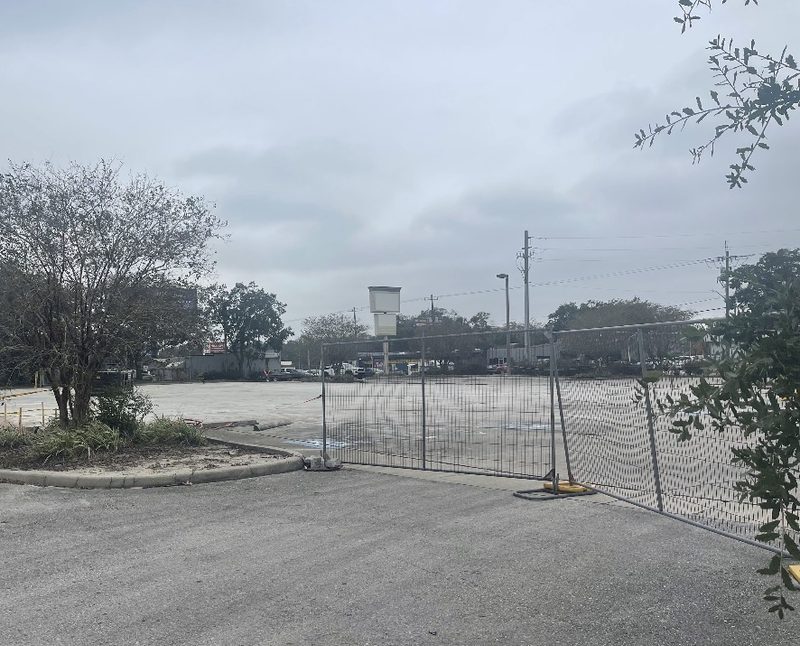
Professional Commercial Demolition Services in Jacksonville
When your business or property requires a clean slate, Demolition Jacksonville delivers safe, efficient, and fully compliant commercial building demolition services across Northeast Florida. From retail strips and office complexes to large warehouses and major corporate locations, our experienced crew handles projects of every scale with precision.
A prime example of our capabilities is our total demolition of the former CVS building located on Atlantic Blvd in Jacksonville. Handled from initial planning through structural teardown and complete debris haul-away, this high-profile project showcases our expertise in executing complex commercial jobs safely, on schedule, and within budget.
Average Cost of Commercial Building Demolition in Jacksonville
Planning your budget is critical for any commercial real estate or redevelopment project. In Jacksonville, FL, commercial building demolition costs typically range from $4 to $30+ per square foot, with total project expenses generally running anywhere from $15,000 to over $100,000+.
The final cost depends on several factors:
- Square Footage & Height: Multi-story structures or massive footprints require specialized heavy machinery and intensive labor.
- Building Materials: Brick, reinforced concrete, and steel structures cost more to dismantle than wood-frame buildings.
- Hazardous Materials: The presence of asbestos, lead paint, or mold requires professional abatement before structural demolition can begin.
- Site Accessibility: Tight urban spaces or busy corridors like Atlantic Blvd may require specialized traffic control and protective fencing.
Get a Precise Quote: Every commercial property is unique. We are proud to provide free estimates for all commercial demolition projects in Jacksonville. Contact us today to evaluate your site and receive a transparent, no-obligation quote.
Frequently Asked Questions (FAQs)
1. What is included in your commercial building demolition services?
Our full-service commercial demolition covers everything from initial site assessments, utility disconnections, and hazardous material coordination to structural teardown, concrete slab removal, and complete debris hauling, leaving your lot ready for new construction.
2. How much does commercial building demolition cost in Jacksonville?
Most commercial teardowns in Jacksonville average between $4 and $30 per square foot, with total project budgets varying based on building size, materials, and specific site requirements.
3. Do you provide free estimates?
Yes! We offer free estimates for all commercial building demolition projects. Our team will inspect your property, evaluate the scope of work, and provide a detailed, itemized quote with no hidden fees.
4. How long does a commercial building demolition project take?
Project duration varies depending on the building’s size and complexity. A small retail strip or standalone store (like our Atlantic Blvd CVS project) can often be completed in a matter of weeks, while large multi-story or industrial complexes may take several months from permitting to final site clearing.
5. Do I need special permits for commercial demolition in Jacksonville?
Yes. Commercial demolition in Jacksonville requires specific local permits and environmental clearances from the city and county. Our team handles the permit acquisition process entirely to ensure your project complies with all local building codes and regulations.
6. How are hazardous materials like asbestos and lead handled?
Prior to any heavy demolition, Florida regulations require thorough testing for hazardous materials such as asbestos and lead paint. If present, certified abatement specialists must safely remove and dispose of these materials before structural tearing begins.
7. What happens to the debris after the building is demolished?
We prioritize sustainable practices. Reusable materials like structural steel and clean concrete are separated and hauled to recycling facilities. Non-recyclable debris is safely transported to approved local landfills in compliance with regional environmental laws.
8. Can you perform selective or interior commercial demolition?
Yes. In addition to complete structural teardowns, we specialize in selective interior strip-outs, tenant improvements, and partial demolitions for commercial spaces undergoing remodeling or re-leasing.
9. What safety measures are implemented during a commercial project?
Safety is our absolute top priority. We utilize professional-grade heavy machinery, dust-suppression systems, perimeter security fencing, and strict OSHA-compliant safety protocols to protect workers, neighboring properties, and the public throughout the entire operation.
How Much Does Residential Demolition Cost in North Florida? | Arwood Site Services Pricing Guide
Tearing down an aging residential structure is a major milestone for property owners, real estate investors, and developers throughout Northeast and North Central Florida. If you are planning a tear-down across Duval, Nassau, St. Johns, Clay, and Flagler Counties, understanding the financial scope helps ensure a smooth project from day one.
At Arwood Site Services, we are committed to transparent, straightforward pricing. Below is an in-depth breakdown of regional pricing dynamics, featured through nine key questions, followed by our material recovery practices, a seven-question FAQ section, and how to connect with our team.
Nine Key Questions & Answers on Residential Demolition Expenses
1. What is the standard price per square foot for home demolition in this region?
- Answer: Residential teardowns generally span between $6 and $15 per square foot. For instance, a modest 1,200-square-foot home typically ranges from $7,200 to $14,000, while expansive structures over 2,500 square feet scale up based on complexity.
2. How do local municipality and county permit fees vary across Duval, Nassau, St. Johns, Clay, and Flagler?
- Answer: Each local building department enforces specific administrative and environmental clearance fees. Permitting costs usually fall between $300 and $1,500, encompassing municipal reviews, environmental notices, and mandatory sign-offs.
3. Does a home built with wood framing cost less to demolish than a concrete block house?
- Answer: Yes, wood-frame dwellings are typically faster to process with lighter machinery, which helps control labor hours. Concrete block and stucco homes demand heavier hydraulic machinery, longer processing windows, and higher debris weight.
4. How much is added to the total project budget for foundation and slab extraction?
- Answer: Breaking down and hauling away a standard concrete slab or stem-wall foundation generally introduces an additional $1,000 to $4,000, depending on concrete thickness, steel reinforcement, and footer depth.
5. Why are professional utility disconnects a critical budgeting factor?
- Answer: Before heavy machinery enters the property, water, sewer, electrical, and gas lines must be legally capped, certified, and signed off. Utility coordination and prep typically run $300 to $800.
6. Are asbestos surveys and environmental clearances mandatory for older properties?
- Answer: Yes, state and federal regulations mandate environmental testing for structures built prior to current guidelines. An initial inspection costs $300 to $700, and any required abatement must be completed by certified technicians before structural demolition starts.
7. How does tight lot spacing or difficult access influence labor and equipment costs?
- Answer: Confined urban spaces (like historic neighborhoods in Jacksonville or St. Augustine) or narrow coastal lots require creative equipment positioning, smaller machines, and increased hand-sorting labor, which can shift the overall quote.
8. How does material recycling help offset total project expenses?
- Answer: Aggressive material diversion reduces heavy tipping fees at landfills. By systematically recycling construction byproducts, we keep overhead lower and pass those operational efficiencies directly to the project budget.
9. What impact do hauling distances and local landfill tipping fees have on pricing?
- Answer: The overall volume of debris dictates how many truckloads are required to clear the site. Local landfill and recycling yard tipping rates in Northeast Florida account for a significant portion of standard demolition proposals.
Material Recovery & Sustainable Practices
At Arwood Site Services, we prioritize eco-conscious site cleanup and responsible waste management. We salvage and process the top building materials from your property:
- Concrete: Crushed on-site or sent to regional recycling facilities to be repurposed as clean fill aggregate.
- Wood: Sorted and routed for recycling, milling, or biomass conversion.
- Steel & Metals: Collected and transported to specialized metal recycling centers.
- Items to Resale from Homes: Architectural salvage, vintage cabinetry, hardware, doors, and unique fixtures are carefully evaluated for resale and diversion from local landfills.
Seven Frequently Asked Questions (FAQs)
- How long does a standard residential demolition project take?
- Most single-family home teardowns take roughly 2 to 5 days once municipal permits are issued and utilities are safely disconnected.
- Does Arwood Site Services manage the required local permits?
- Yes, we handle the entire regulatory permitting lifecycle across Duval, Nassau, St. Johns, Clay, and Flagler Counties.
- Can you clear out in-ground swimming pools during the demolition process?
- Yes, we offer complete concrete and fiberglass pool removal as part of a full site teardown or as an independent service.
- What preparations should a homeowner complete prior to arrival?
- Homeowners should clear out personal belongings, confirm that utility disconnect requests are processed, and ensure clear driveway clearance for equipment transport.
- Are your project estimates truly free?
- Absolutely! We provide clear, no-obligation free estimates for all residential and commercial projects.
- What exact geographic areas do you service in North Florida?
- Our primary operational footprint spans Duval, Nassau, St. Johns, Clay, and Flagler Counties.
- How can I get my project started right away?
- Ready to talk details? Call or text us today at 904-305-7534 for prompt scheduling.
Your Preferred Contractor
When property owners, investors, and builders across Duval, Nassau, St. Johns, Clay, and Flagler Counties need dependable, professional demolition services, they know they want to work with Arwood Site Services. As the preferred contractor in the region, Arwood Site Services brings heavy equipment capability, strict compliance, and reliable execution to every job site.
Call or text 904-305-7534 to schedule your free estimate with the team you can trust.